

Application of butyl hydroxyanisole (BHA) in bakery products
Nov. 30, 2024
1.The Characteristics of BHA
Butylated hydroxyanisole, also known as tert-butyl-4-hydroxyanisole, hydroxyanisole, abbreviated BHA. BHA sold on the market is a mixture of 3-BHA and a small amount of 2-BHA, 3-BHA has a slightly stronger antioxidant effect than 2-BHA, but the two can be used at the same time.
Appearance: BHA is colorless to slightly yellow waxy crystalline powder, easy to caking, with phenolic taste;
Melting point: the melting point varies with the mixing ratio of 3-BHA and 2-BHA, such as 3-BHA accounted for 95%, the melting point is 62℃, the boiling point is 264 ~ 270℃ solubility characteristics: BHA is insoluble in water, soluble in fat and organic solvents, and the solubility reaches 30% in lard (50℃);
Thermal stability: BHA is relatively stable to heat and is not easily destroyed under weak alkaline conditions, so it is a good antioxidant.
Color characteristics: BHA has the characteristic of discoloration due to the interaction with alkaline earth metal ions, so the use of iron and copper containers should be avoided. Mixing citric acid or tartaric acid with this product not only has a synergistic effect, but also can prevent the color effect caused by metal ions.
Volatility: BHA has a certain volatility and can be distilled by steam, so it is easy to lose in high temperature products, especially in cooking products. BHA can also be used in food packaging materials.
BHA has been approved as a antioxidant in China since 1962. According to China's GB 2760 "Food Safety national Standard for the use of food additives" provisions, BHA can be used in all kinds of fat, oil and emulsified fat products, cooked nuts and seeds, biscuits, ready-to-eat cereals, and other oil-rich foods. The maximum amount used is 0.2g/kg (measured by the content in the oil).
2. The Application Advantages of BHA in bakery products.
bakery products are becoming more popular when we choose what to eat, especially in the categories of bread and cake. Grease is an important raw material in the production of baked goods, and it is one of the key factors to determine the quality of its products. Grease rancidity will lead to sensory and nutritional degradation of the product, and will have adverse effects on the human body after ingestion. BHA can provide hydrogen atoms to combine with free radicals, generated by oil autooxidation to form a relatively stable structure, blocking the chain autooxidation process of oil, and is suitable for anti-oxidation of fat food and fat-rich food. BHA is relatively stable to heat, not easy to destroy under weak alkaline conditions, and could remain effective in the baking process.
The antioxidant effect of BHA on animal fats is more effective than that on unsaturated vegetable oils, and it is especially suitable for bakery products with animal fats. According to the study of Dai Xiusheng [1], the use of BHA in fat and oily baked and fried foods can extend the shelf life by 5-8 times (Figure 1). The dosage of BHA is generally less than 0.02%, and the effect increases when used with a synergist (Table 1).
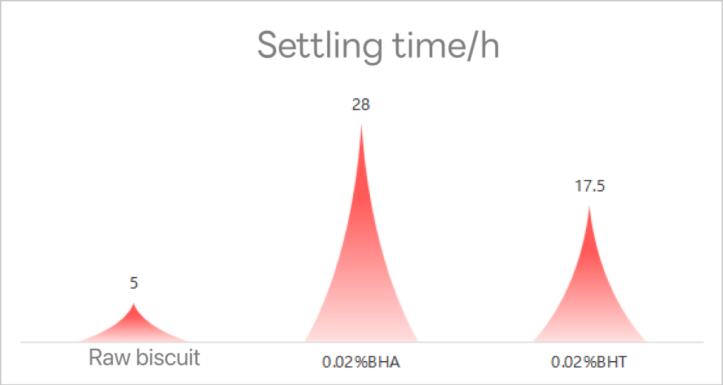
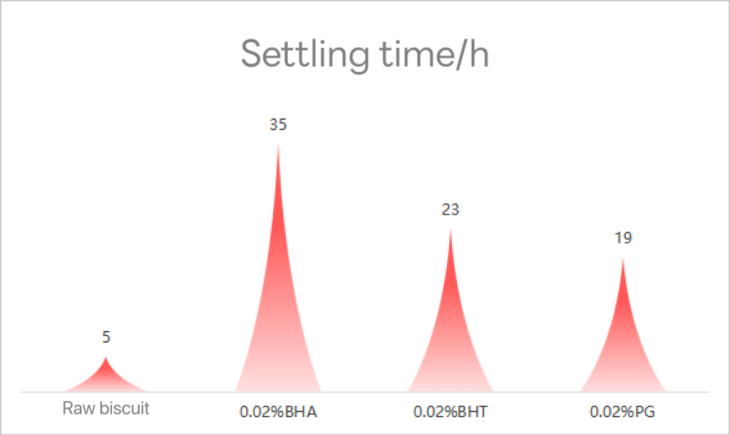
FIG.1 Effect of several antioxidants on prolonging the storage period of food prepared from lard (storage temperature 63℃)
Source: Dai Xiu-Sheng, Shanghai Food Science and Technology, 1982(03): 41–44. [1]
Table 1 Effects of BHA additive on the stability of lard AOM
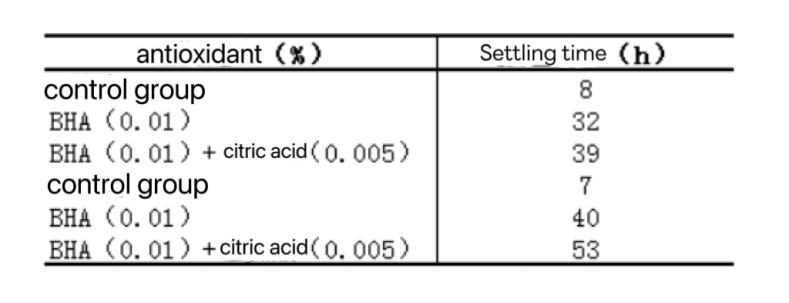
Source: Dai Xiu-Sheng, Shanghai Food Science and Technology, 1982(03): 41–44.
In addition, BHA is added to baking oil and salt to maintain the aroma of bakery products and salted peanuts and extend the shelf life of bakery products. BHA can be combined with other fat-soluble antioxidants for better performance, such as BHA and BHT in combination to better protect lard, chicken fat and other fats. In addition to its antioxidant effects, BHA also has antibacterial effects. Studies have shown that 0.015% BHA can inhibit Staphylococcus aureus, 0.028% BHA can prevent the growth of parasitic aspergillus spores, and hinder the production of aflatoxin.
3. Precautions for Using BHA
The product is easy to lump: the melting point of BHA is relatively low (melting point :48~63℃), and has volatile characteristics, coupled with the high temperature and extrusion in the transportation and storage process, will have a certain effect on the appearance of BHA, resulting in a caking state of the product, but will not affect the use effect of BHA products.
Timing and method of use: Antioxidants must be used before food oxidation occurs. Since the amount of antioxidants used is generally small, it should be evenly dispersed in the food in order to play a better role. For example, in the production of mooncakes, the antioxidants used are added to the filling, cover oil and mooncake crust. For fat pork and nuts, antioxidant impregnation is mainly used to delay the deterioration of these substances.
Combination with synergists: The combination of more than two antioxidants, or the combination of synergists, the antioxidant effect is much better than the use of a single antioxidant. The chelation of metal ions can promote oxidation, so citric acid, phosphoric acid, ascorbic acid or other organic acids that passivate metal ions can be used as an antioxidant synergist, and the dosage is generally 1/4 to 1/2 of the antioxidant.
Control of factors affecting the reducibility of antioxidants: To make antioxidants fully play their role, various factors affecting their reducibility must be controlled, such as light, heat, oxygen and so on. Ultraviolet light and heating in the sun can not only promote the oxidation of food, but also cause decomposition and volatilization of antioxidants, so attention should be paid to it when used.
Nitrogen filling or vacuum sealing measures: The use of antioxidants at the same time to place preservatives, nitrogen filling or vacuum sealing measures can reduce further contact between food and oxygen, and its antioxidant effect is better.
About L&P Food Ingredient Co., Ltd
L&P Food Ingredient Co., Ltd (L&P Foods) is a professional manufacturer specializing in food additives and functional food ingredients. The company holds comprehensive production qualifications, including valid manufacturing licenses and a full range of internationally recognized management system certifications, including Quality Management (ISO 9001), Food Safety Management (ISO 22000), Religious Certifications (KOSHER and HALAL), Occupational Health and Safety (ISO 45001), Environmental Management (ISO 14001), as well as the Global Standard for Food Safety (BRC). With consistent and reliable product quality, a well-established after-sales service system, and the capability to provide customized solutions tailored to customer needs, L&P Foods has become a trusted and preferred supplier for downstream manufacturers.
Reference:
[1] Dai Xiu-Sheng, antioxidant tert-butyl-4-hydroxyanisole and propyl gallate (PG) [J]. Shanghai Food Science and Technology, 1982 (03) 41-44.
[2]黄璐瑶,梁鹏. 食用油脂氧化的控制措施研究进展[J].食品安全导刊,2017,(21):31.DOI:10.16043/j.cnki.cfs.2017.21.021.
Latest Blogs
-
Sep. 21, 2026
【Food Antioxidants Series 6】 A Key Player in Lipid Preservation | Propyl Gallate (PG)
-
Sep. 21, 2026
[Exhibition Review] L&P Foods Showcases Diverse Ingredient Solutions at Fi Asia Indonesia 2026
-
Sep. 18, 2026
【Food Antioxidants Series 5】 A New Force in Natural Antioxidants | Marigold Flavonoids
-
Sep. 18, 2026
-
Sep. 15, 2026
How TBHQ Extends Shelf Life in Oils and Snacks: Mechanism and Usage Tips