

【Brain Health Ingredient Series 10】 L-Theanine: A Natural Amino Acid That Keeps the Brain “Relaxed Yet Alert”
May. 26, 2026
1. What Is L-Theanine?
L-Theanine (scientific name: N-ethyl-γ-L-glutamine) is a natural non-protein amino acid first isolated from green tea in 1949 [1]. It mainly exists in plants of the Camellia family, with the highest concentration found in green tea (accounting for 1%–2% of tea dry weight), and is one of the key components responsible for the fresh and savory taste of tea. Since the human body cannot synthesize it naturally, it must be obtained through diet or supplementation. L-Theanine helps regulate neurotransmitter activity in the brain, promoting a state of “relaxation without drowsiness and focus without anxiety,” and is therefore known as a “natural brain-calming ingredient.”
-
Basic Characteristics
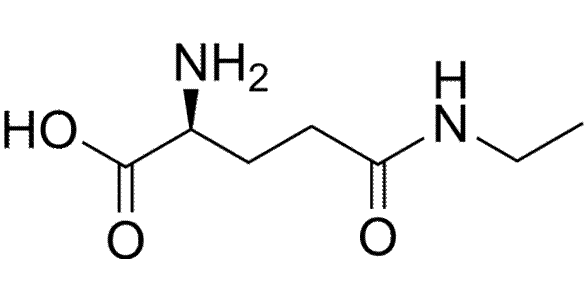
Image source: MedChemExpress
Naturally occurring L-Theanine exists primarily in the L-form (the D-form has low biological activity), and the pure compound appears as white needle-like crystals. It is highly soluble in water, with a slightly acidic aqueous solution, and possesses a caramel-like aroma and refreshing umami taste. It is insoluble in anhydrous ethanol and ether, and exhibits good stability. After oral administration, L-Theanine shows high intestinal absorption efficiency and reaches peak brain concentration within 30–60 minutes [3]. It is mainly distributed in the hippocampus and prefrontal cortex, exerting mild, non-stimulating effects suitable for various dosage forms. The main production methods include plant extraction, biosynthesis, enzymatic synthesis, and chemical synthesis [2].
-
Functional Benefits: Multi-Dimensional Support from Mood Regulation to Cognitive Enhancement
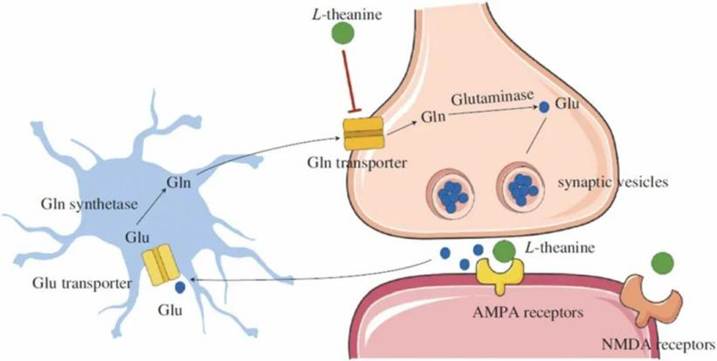
Image source: WeChat Official account “Synthetic Biology and High-Value Compounds.”
1. Influencing Neurotransmitters and Protecting the Nervous System:
As a structural analog of glutamate, L-Theanine can competitively bind to glutamate receptors to inhibit excitotoxicity [14] and reduce neuronal apoptosis [4], thereby protecting brain tissues. Meanwhile, it can regulate serotonin [15], dopamine, and gamma-aminobutyric acid (GABA) levels [5], thus influencing learning and memory functions.
2. Cognitive Improvement:
L-Theanine may help intervene in neurodegenerative diseases by inhibiting the NF-κB inflammatory pathway, upregulating the Alzheimer’s disease (AD) therapeutic target protein SIRT1, and promoting neural regeneration [8]. In addition, it can regulate neurotransmitter balance and reduce cortisol secretion [10], thereby relieving stress and anxiety.
3. Enhancing Attention and Focus:
L-Theanine can significantly increase the intensity of alpha brain waves (which indicate a relaxed yet alert mental state) [7], while suppressing excessive activation of beta brain waves (associated with stress and excitement) [6]. This regulation helps the brain remain relaxed while maintaining alertness and concentration, thereby improving attention deficits and low cognitive work efficiency [13].
IV. Regulatory Status: Globally Recognized as a “Safe Food Ingredient” [12]
1. Japan:
In 1964, the Ministry of Health, Labour and Welfare of Japan approved L-Theanine as a food additive. It may be used as a flavoring agent and nutrient fortifier without usage limitations. It can also be used as a functional ingredient in foods with functional claims.
2. United States:
In 2000, the U.S. FDA granted L-Theanine GRAS (Generally Recognized as Safe) status, allowing its use in sports drinks, juices, non-herbal beverages, chewing gum, hard candy, mints, chocolate energy bars, and chewable tablets. The FDA recommends that the total daily intake should not exceed 1200 mg.
3. China:
In July 2014, China’s National Health Commission approved tea-derived L-Theanine as a “New Food Ingredient” (Ministry of Health Announcement No.15 of 2014). Its application does not include infant foods, and the recommended daily intake is ≤400 mg/day.
V. Clinical Research Support: Scientifically Verified Mild Regulatory Effects
1. Chu et al. reported in animal studies [2] that oral administration of 180 mg/day L-Theanine significantly improved rats’ learning performance in the Operant test compared with the control group. In addition, the Avoidance test also confirmed that L-Theanine could enhance memory function in rats.
2. In a randomized, double-blind, placebo-controlled crossover trial [9], 30 healthy adults consumed either 200 mg/day L-Theanine or a placebo for four consecutive weeks. Results showed that L-Theanine significantly improved stress conditions, sleep quality, and cognitive performance scores.
3. A double-blind study involving individuals aged 50–69 [16] demonstrated that both single-dose and continuous 12-week daily supplementation with 100 mg L-Theanine shortened reaction time in attention tasks, increased the number of correct responses, and reduced working memory omission errors according to Cognitrax evaluations. The mechanism may involve reallocating attentional resources and enhancing mental concentration, thereby improving attention, working memory, and executive function.
VI. Safety: Long-Term Supplementation Without Side Effects or Dependence
1. Acute Toxicity:
The oral LD50 in mice exceeds 5000 mg/kg [11], far above clinical dosage levels.
2. Subchronic Toxicity:
Currently, there is no clear evidence indicating subchronic toxicity associated with L-Theanine.
3. Reproductive and Developmental Toxicity:
At present, there is no clear evidence suggesting the teratogenicity of L-Theanine.
4. Long-Term Safety:
Long-term studies (400 mg/day for 24 months) showed no abnormalities in liver function, kidney function, blood routine tests, or neurological function, and no evidence of drug dependence.
5. Possible Mild Side Effects:
Only a small number of sensitive individuals may experience mild dizziness or gastrointestinal discomfort (such as bloating) at high doses (>600 mg/day), which generally resolves after discontinuation.
VII. Recommended Intake
1. Daily Anxiety Relief / Focus Enhancement:
100–200 mg/day, taken 1–2 times daily. It may be combined with 50–100 mg caffeine to synergistically enhance focus while reducing caffeine-related side effects.
2. Sleep Quality Improvement:
200–400 mg/day, taken 30–60 minutes before bedtime. It may be combined with 100 mg GABA or 300 mg magnesium to enhance relaxation and sleep-supporting effects.
3. Overall Recommendation:
The recommended intake range of L-Theanine is 100–400 mg/day.
VIII. Precautions
1. Although non-addictive, long-term excessive intake (e.g., >1000 mg/day) is not recommended, as it may cause mild dizziness or fatigue in some individuals due to excessive relaxation. Symptoms usually improve quickly after dosage reduction.
2. Due to insufficient safety data, pregnant and breastfeeding women are not recommended to take additional L-Theanine supplements.
3. Although no clear drug interactions have been identified, individuals taking anti-anxiety medications or sedative-hypnotics are advised to consult a physician before supplementation to avoid excessive drowsiness caused by additive effects.
4. L-Theanine should not replace medication. Individuals diagnosed with anxiety disorders, depression, or other psychiatric conditions should follow medical advice and standardized treatment. L-Theanine should only be used as an adjunctive mood-support supplement.
5. There is no need to worry about “caffeine dependence.” L-Theanine itself does not contain caffeine, and when combined with caffeine, it does not increase caffeine dependence; instead, it may help reduce caffeine-induced overstimulation.
References
[1]Chong X ,Hou J ,He F H . Pharmaceutical Activities of Theanine: A Phytochemical Nutrient.[J].Food science & nutrition,2025,13(8):e70811.DOI:10.1002/FSN3.70811.
[2]Le J ,Li L ,Wang C , et al. The function and application potential of L-theanine: From biotechnological production, biosynthesis, bioactivity to food industry.[J].Food chemistry,2025,492(Pt 3):145613.DOI:10.1016/J.FOODCHEM.2025.145613.
[3]付佳音,王龙华,闫瑞瑞,等. L-茶氨酸研究的可视化分析及其功能活性和食品应用研究进展[J/OL].食品工业科技,1-18[2025-10-14].https://doi.org/10.13386/j.issn1002-0306.2024120316.
[4]王沙凝,彭云,刘摇,等. 关于L-茶氨酸功能作用机制研究进展[J].食品工业,2025,46(04):164-168.DOI:CNKI:SUN:SPGY.0.2025-04-034.
[5]Park K M ,Choi Y B ,Kho R A , et al. L-theanine ameliorates traumatic-brain-injury-induced hippocampal neuronal death in rats[J].Phytomedicine,2025,139156457-156457.DOI:10.1016/J.PHYMED.2025.156457.
[6]Han Z ,Wang L ,Zhu H , et al. Uncovering the effects and mechanisms of tea and its components on depression, anxiety, and sleep disorders: A comprehensive review[J].Food Research International,2024,197(P1):115191-115191.DOI:10.1016/J.FOODRES.2024.115191.
[7]Wang F ,Huang X ,Wang W , et al. L-Theanine Effectively Protects Against Copper-Facilitated Dopamine Oxidation: Implication for Relieving Dopamine Overflow-Associated Neurotoxicities[J].Molecular Neurobiology,2024,62(4):1-13.DOI:10.1007/S12035-024-04601-X.
[8]宋怡瑶,胡珂宇,马浩源,等. 茶多酚、茶氨酸与血管性认知障碍的研究进展[J].卒中与神经疾病,2020,27(03):421-423.DOI:CNKI:SUN:ZZYS.0.2020-03-037.
[9]Hidese S ,Ogawa S ,Ota M , et al. Effects of L-Theanine Administration on Stress-Related Symptoms and Cognitive Functions in Healthy Adults: A Randomized Controlled Trial[J].Nutrients,2019,11(10):2362-2362.DOI:10.3390/nu11102362.
[10]周昕丽,马静,翟诗琪,等. 饮茶对认知功能的影响[J].世界最新医学信息文摘,2019,19(59):112-114+118.DOI:10.19613/j.cnki.1671-3141.2019.59.052.
[11]Duygu T ,Nevin Ş . L-theanine, unique amino acid of tea, and its metabolism, health effects, and safety.[J].Critical reviews in food science and nutrition,2017,57(8):1681-1687.DOI:10.1080/10408398.2015.1016141.
[12]帅玉英,沈宇峰,黄海娟,等. 功能性配料茶氨酸的生产应用与法规情况简介[J].中国食品添加剂,2013,(S1):215-219.DOI:CNKI:SUN:ZSTJ.0.2013-S1-045.
[13]Higashiyama A ,Htay H H ,Ozeki M , et al. Effects of l -theanine on attention and reaction time response[J].Journal of Functional Foods,2011,3(3):171-178.DOI:10.1016/j.jff.2011.03.009.
[14]石亚亚,贾尚智,闵彩云. 茶氨酸保健功能研究进展[J].氨基酸和生物资源,2010,32(01):52-56+66.DOI:10.14188/j.ajsh.2010.01.014.
[15]Manuel G ,P S K ,L J M , et al. The effects of L-theanine on alpha-band oscillatory brain activity during a visuo-spatial attention task.[J].Brain topography,2009,22(1):44-51.DOI:10.1007/s10548-008-0068-z.
[16]Gregory E ,V B S . Pharmacology and therapeutic uses of theanine.[J].American journal of health-system pharmacy : AJHP : official journal of the American Society of Health-System Pharmacists,2006,63(1):26, 28-30.
Latest Blogs
-
Sep. 21, 2026
【Food Antioxidants Series 6】 A Key Player in Lipid Preservation | Propyl Gallate (PG)
-
Sep. 21, 2026
[Exhibition Review] L&P Foods Showcases Diverse Ingredient Solutions at Fi Asia Indonesia 2026
-
Sep. 18, 2026
【Food Antioxidants Series 5】 A New Force in Natural Antioxidants | Marigold Flavonoids
-
Sep. 18, 2026
-
Sep. 15, 2026
How TBHQ Extends Shelf Life in Oils and Snacks: Mechanism and Usage Tips