

【Brain Health Ingredient Series 5】 Docosahexaenoic Acid (DHA): The “Neural Gold” for Building the Brain
Apr. 20, 2026
1. What is Docosahexaenoic Acid (DHA)?
Docosahexaenoic acid (DHA) is an omega-3 polyunsaturated fatty acid [1] that the human body cannot synthesize on its own, and thus must be obtained from dietary sources. It is classified as an 'essential fatty acid.' DHA constitutes about 20% of the brain’s gray matter and approximately 50% of the retina, making it a critical nutrient for brain function and visual health from fetal development through adulthood [2]. Natural sources include deep-sea fish such as salmon and tuna, as well as microalgae, and it is a key component in infant formula.
2.Basic Characteristics
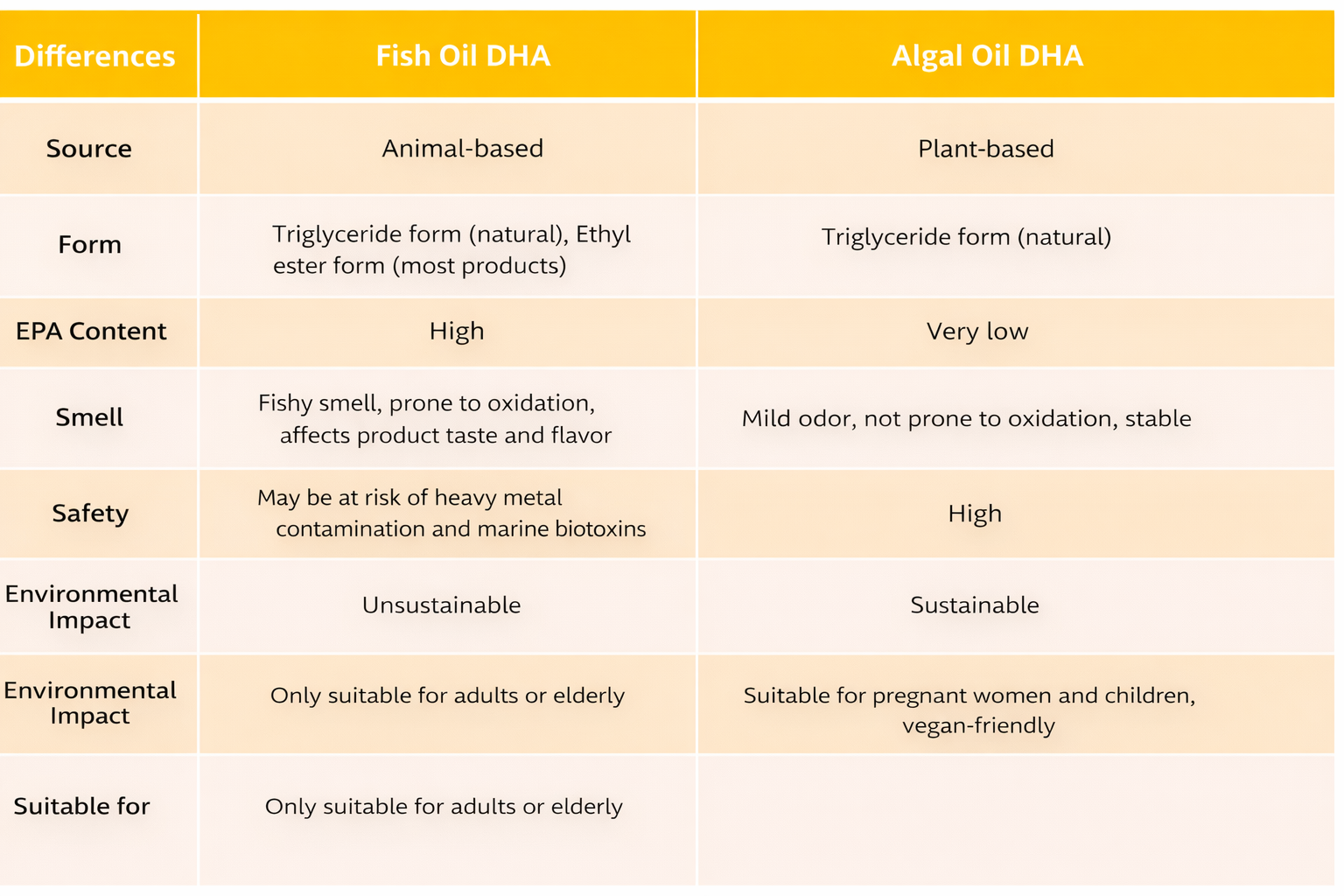
(Image source: Food Research Association)
DHA is a light yellow to orange oily liquid that is soluble in most organic solvents but poorly soluble in water. It is sensitive to heat, oxygen, and light, and prone to oxidative degradation [3]. As a lipid-soluble compound, DHA must be consumed with dietary fats for optimal absorption (30–50%) [14]. It can cross both the blood–brain barrier and the retinal barrier, where it preferentially accumulates in the hippocampus (the memory center) and retinal photoreceptor cells [4,21]. The main production methods include fish oil extraction and microbial fermentation.
3. Functional Effects: From Metabolic Regulation to Cognitive Protection
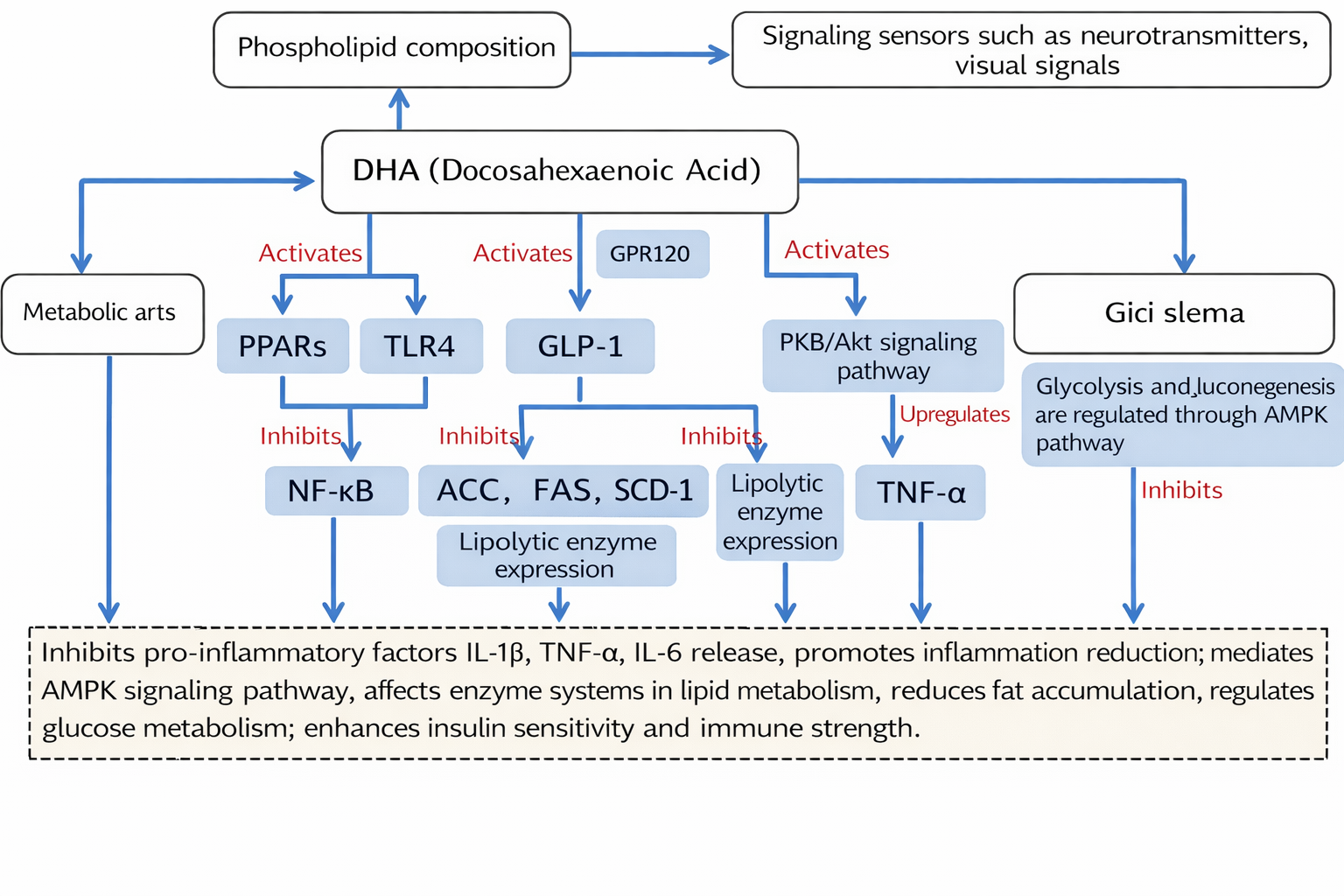
Image source:Bie Nana. Neuroprotective Effects of Docosahexaenoic Acid and Its Mechanism Research [D]. Tianjin University of Science and Technology, 2022.
• Delays Cognitive Decline in the Elderly: DHA enhances neuronal membrane fluidity and increases the secretion of soluble amyloid precursor protein-alpha (sAPPα) [7,19], modulating secretase activity to reduce the formation and aggregation of β-amyloid (Aβ). These effects lower the risk of Alzheimer’s disease [7,19]and improve symptoms such as memory loss and slower response times in the elderly [24].
• Inhibits Oxidative Stress and Inflammation to Protect Neuronal Cells [23]: DHA is metabolized into protectins and resolvins, which not only mitigate inflammation [5,17] but also exert neuroprotective effects [6,20] by inhibiting the expression [8] and release of adhesion molecules and inflammatory mediators.
4. Regulatory Status: A Globally Recognized Essential Nutrient
• China: In March 2010, the Ministry of Health officially approved DHA algal oil (from Schizochytrium and other microalgae) as a new food resource (Announcement No. 3, 2010), with a recommended intake of ≤300 mg/day (as pure DHA). In 2023, DHA algal oil was listed in the 'Health Food Raw Material Catalogue – Nutrient Supplements (2023 Edition).
• United States: The FDA has granted both GRAS and NDIN certifications for DHA, allowing its use in various foods. Recommended intake is 300 mg/day for pregnant women and 1 g/day for older adults.
• European Union: DHA algal oil derived from Schizochytrium sp. is authorized as a novel food for use in both infant and general food products. The established safe upper limit for adults is 3 g/day.
• Australia & New Zealand: In 2017, FSANZ approved DHA algal oil from Schizochytrium sp. for use in infant formula.
• Japan: Foods containing microalgae-derived DHA are classified directly as processed foods.
• World Health Organization (WHO): Recommends 20 mg/kg DHA per day for infants and a combined daily intake of 200–500 mg EPA + DHA for adults to help prevent chronic diseases.
5. Clinical Research Support: The “Golden Nutrient” for Brain Development
• A double-blind, randomized, placebo-controlled study involving 102 healthy middle school students was conducted over 30 days. The experimental group received daily DHA algal oil softgels, while the control group received placebos without DHA. Cognitive assessments—including memory scales, recall tests, and blood DHA levels—showed that the DHA group exhibited significant improvements in short-term memory retention, information recall, and attention, indicating notable short-term cognitive benefits.
• A double-blind clinical trial by the University of Gothenburg, Sweden, demonstrated [22] that daily supplementation with 1.8 g of DHA for 24 months in older adults with mild cognitive impairment resulted in a 19% improvement in memory test performance and a 40% slower rate of hippocampal volume loss, suggesting substantial neuroprotective effects.
• A meta-analysis covering 15 randomized controlled trials (RCTs) confirmed that [24], among healthy adults aged 18–90 years, whether or not they had mild memory complaints, daily DHA supplementation averaging over 580 mg led to significant enhancement of episodic memory performance.
• A longitudinal cohort study of 1,490 dementia-free adults aged 65 and above [10], with a median follow-up of 7.2 years, found that individuals with higher blood DHA levels had a 49% lower risk of developing Alzheimer’s disease and a 44% lower risk of all-cause dementia.
6. Safety Profile: Long-Term Use without Adverse Effects
• Acute toxicity studies have shown that even a single dose far exceeding the recommended level (up to 10 g) caused no adverse reactions such as nausea or diarrhea.
• Long-term studies (3 g/day for 5 years) demonstrated no abnormalities in liver, kidney, or coagulation function, and no dependence.
• In special populations—pregnant or lactating women, and infants—DHA supplementation within the recommended range is not only safe but also beneficial for fetal and infant development [11,12]. Mild gastrointestinal discomfort (e.g., bloating) may occur in a small number of individuals and can be alleviated by taking DHA with meals.
7. Recommended Intake
• Infants (0–3 years): Obtain DHA through breast milk (with maternal DHA supplementation), formula, or algal oil DHA. Recommended 100 mg/day.
• Children and adolescents (4–17 years): 250–500 mg/day, achievable through deep-sea fish consumption (2–3 times weekly, 100 g per serving) or algal/fish oil supplements.
• Adults: 250–1000 mg/day; for individuals engaged in intensive mental work, 1000–2000 mg/day. Algal DHA is recommended for its higher purity and absence of fishy odor.
• Elderly: 1000–2000 mg/day, divided into two doses with meals. Co-supplementation with vitamin E is advised to prevent DHA oxidation and improve absorption.
8. Precautions
• When choosing fish oil-based DHA, pay attention to 'purity' and 'heavy metal content.' Always prefer products tested by third-party laboratories to avoid contamination.
• Algal DHA and fish-derived DHA provide equivalent benefits, with the former being ideal for vegetarians or individuals allergic to fish.
• DHA supplements should not replace natural dietary sources—regular consumption of deep-sea fish and nuts rich in omega-3 fatty acids remains important.
• If mild diarrhea occurs after supplementation, reducing the dose or taking DHA with meals usually alleviates the issue.
References:
[1]Lauritzen, L., et al., DHA Effects in Brain Development and Function. Nutrients, 2016. 8(1).
[2]Cao, H., et al., Retinoid X Receptor alpha Regulates DHA-Dependent Spinogenesis and Functional Synapse Formation In Vivo. Cell Rep, 2020. 31(7): p. 107649.
[3]Bazinet, R.P. and S. Laye, Polyunsaturated fatty acids and their metabolites in brain function and disease. Nat Rev Neurosci, 2014. 15(12): p. 771-85.
[4] Hoge A, Tabar V, Donneau AF, et al. Imbalance between omega-6 and omega-3 polyunsaturated fatty acids in early pregnancy is predictive of postpartum depression in a Belgian cohort[J]. Nutrients, 2019, 11(4): 876.
[5] Hsu MC, Tung CY, Chen HE. Omega-3 polyunsaturated fatty acid supplementation in prevention and treatment of maternal depression: putative mechanism and recommendation[J]. J Affect Disord, 2018, 238: 47-61.
[6] Chen H F , Su H M .Fish oil supplementation of maternal rats on an n-3 fatty acid-deficient diet prevents depletion of maternal brain regional docosahexaenoic acid levels and has a postpartum anxiolytic effect[J].Journal of Nutritional Biochemistry, 2012, 23(3):299-305.
[7] Bakouei F, Delavar MA, Mashayekh-Amiri S, et al. Efficacy of n-3 fatty acids supplementation on the prevention of pregnancy induced-hypertension or preeclampsia: a systematic review and meta-analysis[J]. Taiwan J Obstet Gynecol, 2020, 59(1): 8-15.
[8] Cinelli G, Fabrizi M, Ravà L, et al. Association between maternal and foetal erythrocyte fatty acid profiles and birth weight[J]. Nutrients, 2018, 10(4): 402.
[9] Middleton P, Gomersall JC, Gould JF, et al. Omega-3 fatty acid addition during pregnancy[J]. Cochrane Database Syst Rev, 2018, 11(11): CD003402.
[10] Bazinet, Richard P. , and Sophie Layé. Polyunsaturated fatty acids and their metabolites in brain function and disease[J]. Nature Reviews Neuroscience, 2024, 15(12), 771–785.
[11] Ni X , Zhang Z , Deng Z ,et al.Optimizing ARA and DHA in infant formula: A systematic review of global trends, regional disparities, and considerations for precision nutrition[J].Food Research International, 2024, 182.
[12] Damsgaard C T , Lauritzen L , Frkiaer H ,et al.Fish Oil Supplementation Modulates Immune Function in Healthy Infants[J].Nutrition Newsletter, 2007, 137(4):1031.
[13] Aleix S ,L C S ,Nathan T , et al. Red Blood Cell DHA Is Inversely Associated with Risk of Incident Alzheimer's Disease and All-Cause Dementia: Framingham Offspring Study.[J].Nutrients,2022,14(12):2408-2408.DOI:10.3390/NU14122408.
[14] Hesselmar B , Saalman R , Rudin A ,et al.Early fish introduction is associated with less eczema, but not sensitization, in infants[J].Acta Paediatrica, 2010, 99: 1861-1867.
[15] 别娜娜.二十二碳六烯酸的神经保护作用及其机理研究[D]. 天津科技大学, 2022.
[16] 肖敏.高产DHA藻种筛选及相关产品对阿尔茨海默病预防作用的研究[D]. 华中农业大学, 2023.
[18] JACA A, DURÃO S, HARBRON J. Omega-3 fatty acids for the primary and secondary prevention of cardiovascular disease[J]. South African Medical Journal, 2020, 110(12): 1158-1159.
[19] 张焕兰, 段伟文, 孙钦秀, 等. 鱼油ω-3 PUFAs的功能特性研究进展[J]. 食品研究与开发, 2024, 45(06):204-210.
[20] Xu ZJ, Li Q, Ding L, Shi HH, Xue CH, Mao XZ, Wang YM, Zhang TT. Acomparative study of the effects of phosphatidylserine rich in DHA and EPA on Abeta-induced Alzheimer's disease using cell models. Food Funct, 2021, 12: 4411-4423.
[21] 廖芬, 张文青. 肠内营养液添加DHA与颅脑损伤术后脑细胞恢复的相关性分析[J]. 心血管病防治知识(学术版), 2015, (04):43-44.
[22] Daniëlle Swinkels, Myriam Baes. The essential role of docosahexaenoic acid and its derivatives for retinal integrity. Pharmacology & Therapeutics. Volume 247, 2023, 108440. ISSN 0163-7258.
[23] Danielle Swanson, Robert Block, Shaker A. Mousa. Omega-3 Fatty Acids EPA and DHA: Health Benefits Throughout Life. Advances in Nutrition. Volume 3, Issue 1, 2012, Pages 1-7, ISSN 2161-8313.
[24] Stanley I. Rapoport, Epolia Ramadan, Mireille Basselin. Docosahexaenoic acid (DHA) incorporation into the brain from plasma, as an in vivo biomarker of brain DHA metabolism and neurotransmission. Prostaglandins & Other Lipid Mediators. Volume 96, Issues 1–4, 2011. Pages 109-113. ISSN 1098-8823.
[25] Xin Zhang, Tian Yuan, Xuhui Chen, Xuebo Liu, Jun Hu, Zhigang Liu. Effects of DHA on cognitive dysfunction in aging and Alzheimer's disease: The mediating roles of ApoE. Progress in Lipid Research. Volume 93, 2024, 101256. ISSN 0163-7827.
Latest Blogs
-
Sep. 21, 2026
【Food Antioxidants Series 6】 A Key Player in Lipid Preservation | Propyl Gallate (PG)
-
Sep. 21, 2026
[Exhibition Review] L&P Foods Showcases Diverse Ingredient Solutions at Fi Asia Indonesia 2026
-
Sep. 18, 2026
【Food Antioxidants Series 5】 A New Force in Natural Antioxidants | Marigold Flavonoids
-
Sep. 18, 2026
-
Sep. 15, 2026
How TBHQ Extends Shelf Life in Oils and Snacks: Mechanism and Usage Tips