
【Brain Health Ingredient Series 7】Taurine – The “Natural Amino Acid Guardian” for Brain Protection
May. 07, 2026
I. What is Taurine?
Taurine, also known as β-aminoethanesulfonic acid, is a sulfur-containing amino acid that exists in a free form in the human body [1]. Although it does not participate in protein synthesis, it is considered a conditionally essential nutrient for humans. The liver can synthesize taurine from cysteine; however, infants, elderly individuals, and people under high stress may not produce sufficient amounts and therefore require dietary supplementation. Taurine was first isolated from ox bile by German scientists in 1827, which is how it received its name. It is widely distributed in the brain, retina, heart, and other organs, with particularly high concentrations in the hippocampus and cerebellum. Taurine can be obtained from deep-sea fish (such as sardines and oysters), meat, and dairy products, and it plays a critical role in maintaining brain function and neurological health [10].
II. Basic Characteristics
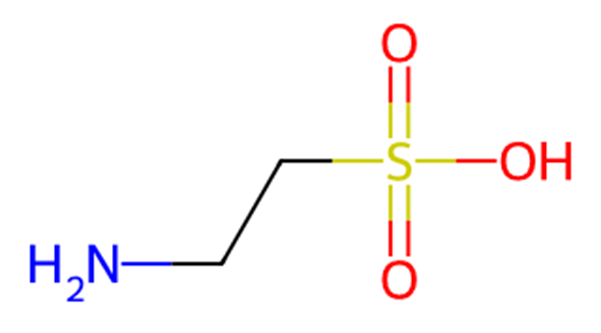
Image Source: ChemSpider
Taurine appears as a white or colorless crystal, is odorless, chemically stable, and not easily decomposed. It is insoluble in organic solvents such as ether. As a small water-soluble amino acid, taurine has an oral absorption rate exceeding 90% and is capable of crossing the blood-brain barrier, allowing it to distribute evenly throughout different brain regions [3]. Taurine directly participates in neural regulation and also acts as an “ion carrier” to promote the absorption of minerals such as calcium and magnesium, thereby supporting brain function. It is suitable for multiple dosage forms including beverages, capsules, and tablets [5], and is mainly produced through biological extraction, fermentation, or chemical synthesis methods.
III. Functional Benefits: Multi-Dimensional Protection from Neuroprotection to Brain Vitality
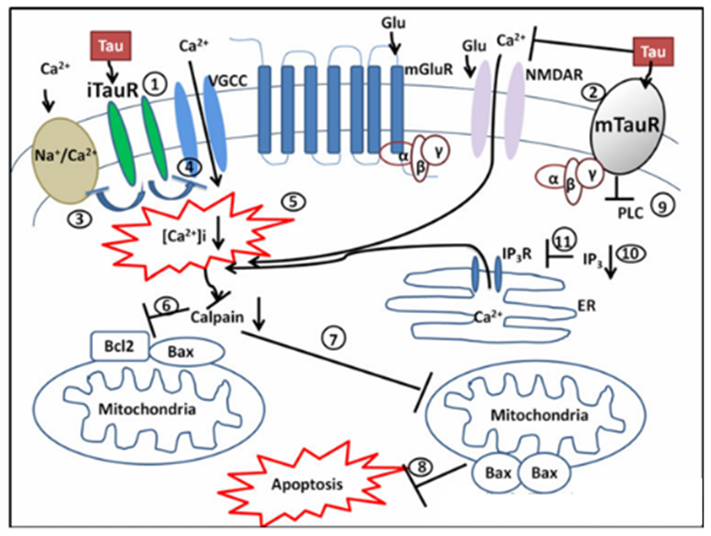
Image Source: Review: taurine: a "very essential" amino acid
1. Protection of Neurons Against Damage
As a potent antioxidant, taurine can directly scavenge reactive oxygen species such as hydroxyl radicals and superoxide anions in the brain [9,16], reducing lipid peroxidation damage [14] to neuronal membranes and protecting neuronal structural integrity.
2. Improvement of Cognition and Memory
Taurine regulates ion channels on neuronal membranes, promotes potassium ion efflux [17], and inhibits excessive calcium ion influx [4]. This helps prevent calcium overload-induced neuronal apoptosis [8], stabilizes neuronal excitability, and improves issues such as poor concentration and memory retrieval difficulties.
3. Relief of Mental Fatigue and Anxiety
Taurine promotes the synthesis of γ-aminobutyric acid (GABA) [6], an inhibitory neurotransmitter, while reducing excessive release of excitatory neurotransmitters such as glutamate [11,18]. This helps maintain neurotransmitter balance, alleviate mental fatigue and anxiety [13], and improve emotional stability.
IV. Regulatory Status: A Globally Recognized Safe Food Ingredient
1. United States
Taurine has received FDA GRAS (Generally Recognized as Safe) certification (GRN No. 586), allowing its use in beverages, candies, dietary supplements, and other food products. In April 2025, the FDA issued new regulations requiring mandatory taurine addition in infant formula with a minimum content standard of ≥0.16 mg/100 mL.
2. European Union
The European Food Safety Authority (EFSA) has approved taurine for use as both a food additive and dietary supplement ingredient, with a recommended adult daily upper intake level of 3,000 mg.
3. China
Taurine is approved in China as both a food nutrition fortifier and food additive. It has also been included in the Pharmacopoeia of the People’s Republic of China for auxiliary treatment of digestive system and liver-related diseases.
4. Japan
In 2009, Japan’s Ministry of Health, Labour and Welfare issued Food Safety Notification No. 0623002, listing taurine as a substance that does not adversely affect human health and allowing its use in functional foods.
V. Clinical Research Support: Evidence-Based Neuroprotective Effects
1. A randomized controlled trial involving 156 liver transplant patients found that supplementation with 2 g of taurine daily for 30 days effectively prevented post-transplant delirium and provided neuroprotective effects.
2. A study on elderly individuals with cognitive decline (MMSE score 23–26) showed [19] that daily supplementation with 1.5 g taurine for 24 weeks improved memory scores by 11.2%, executive function scores by 9.8%, and slowed the rate of cognitive decline by 35%.
3. Research by Ahmed et al. demonstrated [14] that taurine reduces excessive activation of microglia, alleviates key pathological features of Alzheimer’s disease (including toxic protein accumulation and TREM2 receptor regulation), and protects neurons from further damage.
VI. Safety: No Side Effects or Dependency with Long-Term Supplementation
1. Human trials have shown that even a single dose of 10,000 mg—five times higher [15] than conventional supplementation levels—did not cause adverse effects such as nausea, dizziness, or gastrointestinal discomfort.
2. Long-term safety studies (3,000 mg daily for 24 months) demonstrated no abnormalities in liver function, kidney function, or blood parameters. No drug dependency or rebound effects after discontinuation were observed.
Current evidence indicates that taurine intake of ≤3 g/day does not present a significant risk of side effects.
VII. Recommended Intake
1. European Union: EFSA recommends taurine intake not exceed 100 mg/kg body weight per day.
2. China GB 24154 “General Standard for Sports Nutrition Foods”: taurine intake in sports nutrition foods should not exceed 600 mg/day.
3. China GB 14880 “Standard for the Use of Food Nutrition Fortifiers”: taurine addition levels in foods are generally 100–600 mg/kg.
4. China GB 10765 “Infant Formula Food Standard”: taurine is listed as an optional ingredient with a maximum addition level of 3 mg/100 kJ.
5. General adults: the recommended daily dosage is 500–2,000 mg, which can safely and effectively meet physiological needs.
VIII. Precautions
1. Although taurine is considered safe, long-term excessive intake (e.g., >3,000 mg/day) is not recommended, as it may increase kidney burden or disturb intestinal microbiota balance.
2. Taurine may interact with at least 35 different medications. Individuals taking long-term medication should consult a physician before supplementation.
3. Pregnant or breastfeeding women should avoid taurine supplementation due to insufficient safety data.
4. Supplements should not replace natural dietary sources. Consumption of taurine-rich foods such as deep-sea fish, meat, and dairy products is still recommended.
5. Some studies suggest that taurine may promote cancer cell development in certain tumor microenvironments; therefore, cancer patients should strictly limit taurine intake [2].
6. Individuals with severe liver or kidney dysfunction should adjust dosage under medical supervision, as taurine is primarily excreted through the kidneys.
References
[1]刘晶晶,徐蓓蕾,刘树森,等. 褐藻胶寡糖牛磺酸复合物改善东莨菪碱致小鼠认知功能障碍研究[J].食品安全质量检测学报,2025,16(20):305-314.DOI:10.19812/j.cnki.jfsq11-5956/ts.20250418002.
[2]Sharma S ,Rodems J B ,Baker D C , et al. Taurine from tumour niche drives glycolysis to promote leukaemogenesis[J].Nature,2025,644(8075):1-10.DOI:10.1038/S41586-025-09018-7.
[3]胡立国,胡俊杰,魏玉明,等. 牛磺酸的生理功能及其应用[J].饲料工业,2024,45(18):49-54.DOI:10.13302/j.cnki.fi.2024.18.008.
[4]Sharif A ,Ning M ,Jun K , et al. Taurine reduces microglia activation in the brain of aged senescence-accelerated mice by increasing the level of TREM2[J].Scientific Reports,2024,14(1):7427-7427.DOI:10.1038/S41598-024-57973-4.
[5]尤佳伟,陈芬,刘媛,等. 牛磺酸的功效及其在保健食品中的应用研究进展[J].食品安全质量检测学报,2023,14(24):27-34.DOI:10.19812/j.cnki.jfsq11-5956/ts.2023.24.007.
[6]Santulli G ,Kansakar U ,Varzideh F , et al. Functional Role of Taurine in Aging and Cardiovascular Health: An Updated Overview[J].Nutrients,2023,15(19):DOI:10.3390/NU15194236.
[7]Shaghayegh M ,Hamed N ,Mohammad F , et al. The effect of taurine supplementation on delirium post liver transplantation: A randomized controlled trial[J].Clinical Nutrition,2022,41(10):2211-2218.DOI:10.1016/J.CLNU.2022.07.042.
[8]赵慧文,许琳,单姗,等. 牛磺酸对1-溴丙烷致大鼠认知功能障碍的保护作用[J].山东大学学报(医学版),2022,60(02):14-21.
[9]Guizoni M D ,Vettorazzi F J ,Carneiro M E , et al. Modulation of endothelium-derived nitric oxide production and activity by taurine and taurine-conjugated bile acids[J].Nitric Oxide,2020,9448-53.DOI:10.1016/j.niox.2019.10.008.
[10]Ulrike S ,Patricia H ,Gerald R . Taurine: A Regulator of Cellular Redox Homeostasis and Skeletal Muscle Function.[J].Molecular nutrition & food research,2019,63(16):e1800569.DOI:10.1002/mnfr.201800569.
[11]吴平安.牛磺酸改善二型糖尿病大鼠认知障碍和抗海马区神经元凋亡的研究[D].大连医科大学,2019.DOI:10.26994/d.cnki.gdlyu.2019.000343.
[12]Mark W ,David S P ,Jamie T , et al. The Effects of Oral Taurine on Resting Blood Pressure in Humans: a Meta-Analysis.[J].Current hypertension reports,2018,20(9):81.DOI:10.1007/s11906-018-0881-z.
[13]Harris R ,Wen S . Review: taurine: a "very essential" amino acid.[J].Molecular vision,2012,182673-86.
[14]Hernández-Benítez R ,Ramos-Mandujano G ,Pasantes-Morales H . Taurine stimulates proliferation and promotes neurogenesis of mouse adult cultured neural stem/progenitor cells[J].Stem Cell Research,2012,9(1):24-34.DOI:10.1016/j.scr.2012.02.004.
[15]Shao A ,Hathcock N J . Risk assessment for the amino acids taurine, l -glutamine and l -arginine[J].Regulatory Toxicology and Pharmacology,2008,50(3):376-399.DOI:10.1016/j.yrtph.2008.01.004.
[16]王琴,黄慧玲. 牛磺酸对神经细胞损伤的保护作用[J].国际检验医学杂志,2008,29(05):442-444.DOI:CNKI:SUN:GWSQ.0.2008-05-027.
[17]G C I ,W S D ,F P S , et al. Taurine transporter in fetal T lymphocytes and platelets: differential expression and functional activity.[J].American journal of physiology. Cell physiology,2007,292(1):C332-41.
[18]李新娟,葛治国,李东亮,等. 牛磺酸对大鼠脑损伤后认知功能及海马凋亡相关蛋白表达的影响[J].新乡医学院学报,2006,(06):569-571.DOI:CNKI:SUN:XXYX.0.2006-06-016.
[19]梁尚栋,李焕英. 牛磺酸在神经系统中的生理和病理作用[J].国外医学(生理、病理科学与临床分册),2002,(01):76-77.DOI:CNKI:SUN:WYSB.0.2002-01-029.
Latest Blogs
-
Sep. 21, 2026
【Food Antioxidants Series 6】 A Key Player in Lipid Preservation | Propyl Gallate (PG)
-
Sep. 21, 2026
[Exhibition Review] L&P Foods Showcases Diverse Ingredient Solutions at Fi Asia Indonesia 2026
-
Sep. 18, 2026
【Food Antioxidants Series 5】 A New Force in Natural Antioxidants | Marigold Flavonoids
-
Sep. 18, 2026
-
Sep. 15, 2026
How TBHQ Extends Shelf Life in Oils and Snacks: Mechanism and Usage Tips