

【Food Antioxidants Series 1】 A Natural and Efficient Antioxidant Solution | Rosemary Extract
Aug. 12, 2026
With growing consumer demand for “natural” and “clean-label” foods, natural antioxidants are gradually replacing some synthetic antioxidants and becoming a rising choice in the food industry.
Rosemary (Rosmarinus officinalis L.), native to the Mediterranean region, is a valuable aromatic herb known for its fresh fragrance during the growing season and traditional applications in refreshing and revitalizing products. Today, rosemary is also widely cultivated in regions such as Yunnan, Guizhou, and Shandong in China, providing important raw material sources for rosemary extract production.
I. Rosemary Extract
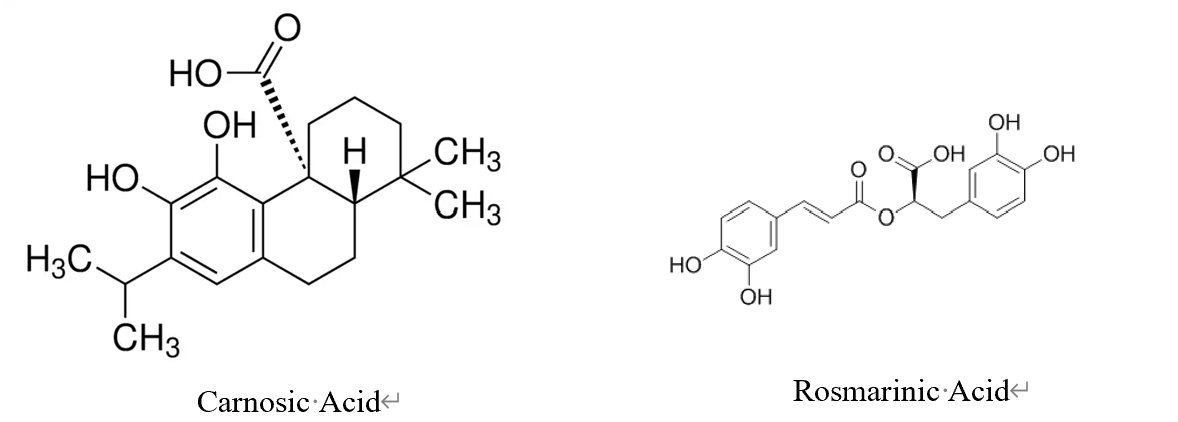
Rosemary extract is a natural botanical extract obtained from the stems, leaves, and flowers of Rosmarinus officinalis L. (rosemary), a plant belonging to the Lamiaceae family, through processes including solvent extraction (such as ethanol and acetone extraction), purification, concentration, and drying [1]. Its key active compounds include phenolic compounds, phenolic acids, and flavonoids, among which carnosic acid and carnosol are the primary antioxidant components [3]. These compounds generally account for more than 5% of the total extract, depending on the extraction and production process.
Rosemary extract is typically produced through low-temperature extraction methods using solvents such as ethanol or supercritical CO₂, while steam distillation is mainly applied for the extraction of rosemary essential oil [8].
Based on different extraction processes, rosemary-derived products can be classified into three main types:
1. Lipid-Soluble Extracts:
Rich in antioxidant compounds, primarily including arnosic acid and carnosol.
2. Water-Soluble Extracts:
Mainly contain rosmarinic acid as the key active compound.
3. Rosemary Essential Oil:
Contains volatile compounds such as 1,8-cineole and α-pinene, and is mainly used in flavoring and preservation applications.
II. Fundamental Characteristics
1. Physical Properties:
The pure extract appears as a light yellow to yellow-green powder. It is readily soluble in ethanol and propylene glycol, but poorly soluble in water and oils. It has the characteristic fresh aroma of rosemary without any off-odors [6].
2. Antioxidant Mechanism:
The key active compounds, including carnosic acid and carnosol, provide phenolic hydroxyl groups [13] that effectively scavenge free radicals, inhibit lipid peroxidation chain reactions, and exhibit strong inhibitory effects on lipid oxidizing enzymes [12].
3. Core Advantages:
With excellent thermal stability, rosemary extract can maintain more than 90% activity under frying conditions at 200°C and remains stable below 250°C [5]. It is one of the few natural antioxidants suitable for high-temperature food processing applications such as fried foods.
4. Stability:
Rosemary extract demonstrates strong stability under both acidic and alkaline conditions and does not undergo color reactions with metal ions [10], ensuring no impact on food appearance. Its stability is also minimally affected by light and oxygen exposure, facilitating storage and handling.
5. Additional Functional Benefits:
Beyond antioxidant activity, rosemary extract offers various functional properties, including flavor enhancement, anti-inflammatory effects [7], antimicrobial activity [9], potential anticancer properties [14,15], cardiovascular and neuroprotective benefits [4], and skin protection effects.
III. Widely Recognized Globally, Natural Properties Gain Growing Market Preference
China: Rosemary extract is approved as a natural food antioxidant and can be used in various food categories. The permitted usage levels vary depending on the specific food application.
European Union: Rosemary extract is officially approved for use as food additive E392 under Regulation (EC) No 1333/2008 on food additives. The total content of carnosic acid and carnosol in the extract is required to be no less than 5%. Its approved applications cover a wide range of products, including edible oils and fats, meat products, and baked goods.
United States: The U.S. FDA recognizes rosemary extract as a Generally Recognized as Safe (GRAS) substance. It can be used for food preservation and flavor enhancement without specific maximum usage limits.
Japan: Rosemary extract is approved for use primarily in edible oils, seafood products, and seasonings. Japan emphasizes “natural extract” labeling and encourages its application in natural food products.
IV. Safety Profile
Rosemary extract is a naturally derived botanical extract. Extensive toxicological studies have demonstrated that it has no acute or chronic toxicity and shows no carcinogenic, teratogenic, or mutagenic effects, indicating a high level of safety.
Toxicological Data: The Joint FAO/WHO Expert Committee on Food Additives (JECFA) has evaluated the acceptable daily intake (ADI) of carnosic acid as 0–0.3 mg/kg body weight.
V. Applications and Usage Limits
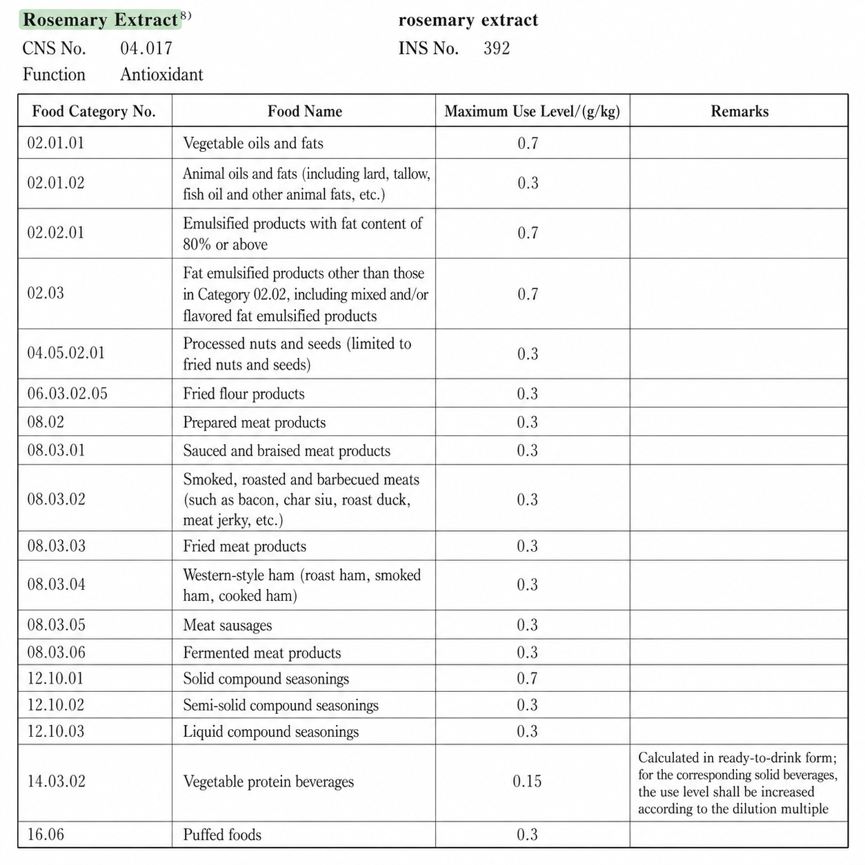
According to the requirements of GB 2760-2024 National Food Safety Standard for the Use of Food Additives, the approved application scope and usage limits of rosemary extract are as follows:
VI. Precautions
1. Compatibility Considerations:
Rosemary extract should not be mixed with alkaline substances (such as sodium bicarbonate), as this may reduce its antioxidant activity. It can be combined with other natural antioxidants, such as vitamin E and tea polyphenols, to achieve enhanced antioxidant performance [13].
2. Storage Conditions:
The product should be stored in a sealed container under light-protected, cool, and dry conditions (recommended storage temperature ≤20°C). Exposure to moisture, direct sunlight, or high temperatures should be avoided, as these conditions may cause the loss of active compounds and reduce antioxidant effectiveness.
3. Usage Control:
Usage levels should strictly comply with regulatory limits. Excessive addition may result in an overly strong aroma and negatively affect food flavor (such as an intense rosemary odor). Appropriate dosage adjustment is particularly important for foods with mild flavors [2].
4. Dissolution Method:
Before use, rosemary extract can be pre-dissolved in a small amount of ethanol and then incorporated into food ingredients to ensure uniform dispersion. This helps prevent localized high concentrations that may affect food taste and appearance.
5. Allergy Considerations:
As rosemary extract contains volatile terpenes, sensitive individuals should use it with caution, and appropriate labeling should be provided where necessary.
Rosemary extract is a “natural, safe, and effective” multifunctional antioxidant solution, offering combined benefits of antioxidant protection, flavor enhancement, and antimicrobial activity. It is compatible with various food processing applications, particularly high-temperature processing, helping extend shelf life while enhancing the natural positioning of food products. As a result, rosemary extract has become an excellent natural alternative to synthetic antioxidants in the food industry.
References:
[1]周莹,邓文,李绍钰. 迷迭香酸的来源、提取方式、生物学功能及其在动物生产中的应用[J].饲料研究,2025,48(23):149-153.DOI:10.13557/j.cnki.issn1002-2813.2025.23.025.
[2]杨孔,严文芳. 迷迭香在食品添加剂中的应用研究进展[J].广东化工,2025,52(05):86-87+103.
[3]张彦昕,柴贝贝,石玉节,等. 迷迭香三种成分提取及其体外抗氧化和抑菌活性研究[J].云南化工,2025,52(01):63-68.
[4]吴琳.大鼠重复性轻型脑损伤后海马损伤及迷迭香干预的机制研究[D].昆明医科大学,2024.DOI:10.27202/d.cnki.gkmyc.2024.001757.
[5]冯爽,郭娟. 迷迭香提取物在肉类食品保鲜性能方面的应用与评价[J].中国食品,2024,(20):150-153.
[6]王慧,刘刚强,李天佑,等. 迷迭香的化学成分及应用研究进展[J].食品科学,2024,45(20):2024-2034.
[7]Schmidt J ,Juhasz K ,Bona A . Exploring the Chemical Profile, In Vitro Antioxidant and Anti-Inflammatory Activities ofSantolina rosmarinifoliaExtracts[J].Molecules,2024,29(7):DOI:10.3390/MOLECULES29071515.
[8]库文娟,杨欢,余丽,等. 从迷迭香中提取天然抗氧化剂的工艺研究进展[J].食品工业,2023,44(12):159-161.
[9]曾发姣,周小玲,汪彬,等. 迷迭香提取物及其活性成分的抑菌作用研究进展[J].湖南农业科学,2023,(07):110-114.DOI:10.16498/j.cnki.hnnykx.2023.007.022.
[10]李凌娜,杨继威,张丽芬,等. 响应面法优化低共熔溶剂提取迷迭香中迷迭香酸和鼠尾草酸的工艺[J].食品工业科技,2023,44(16):218-227.DOI:10.13386/j.issn1002-0306.2022100094.
[11]朱志妍,田浩,潘俊,等. 迷迭香提取物的制备及抗氧化、抑菌活性研究进展[J].食品工业科技,2023,44(12):461-469.DOI:10.13386/j.issn1002-0306.2022060161.
[12]王莹,曾祥辉,邓慧,等. 迷迭香脂溶性抗氧化剂活性及抑制食用植物油脂氧化作用研究[J].中国调味品,2022,47(08):80-84.
[13]Mira-Sánchez D M ,Castillo-Sánchez J ,Morillas-Ruiz M J . Comparative study of rosemary extracts and several synthetic and natural food antioxidants. Relevance of carnosic acid/carnosol ratio[J].Food Chemistry,2020,309125688.DOI:10.1016/j.foodchem.2019.125688.
[14]Pérez-Sánchez A ,Barrajón-Catalán E ,Ruiz-Torres V , et al. Rosemary Rosmarinus officinalis extract causes ROSinduced necrotic cell death and inhibits tumor growth in vivo[J].Scientific Reports,2019,9(1):1-11.DOI:10.1038/s41598-018-37173-7.
[15]Moore J ,Yousef M ,Tsiani E . Anticancer Effects of Rosemary (Rosmarinus officinalis L.) Extract and Rosemary Extract Polyphenols[J].Nutrients,2016,8(11):731.DOI:10.3390/nu8110731.
Latest Blogs
-
Sep. 21, 2026
【Food Antioxidants Series 6】 A Key Player in Lipid Preservation | Propyl Gallate (PG)
-
Sep. 21, 2026
[Exhibition Review] L&P Foods Showcases Diverse Ingredient Solutions at Fi Asia Indonesia 2026
-
Sep. 18, 2026
【Food Antioxidants Series 5】 A New Force in Natural Antioxidants | Marigold Flavonoids
-
Sep. 18, 2026
-
Sep. 15, 2026
How TBHQ Extends Shelf Life in Oils and Snacks: Mechanism and Usage Tips