

【Food Antioxidants Series 2】 Highly Efficient Oil Protection Solution | Tertiary Butylhydroquinone (TBHQ)
Sep. 01, 2026
In the modern food industry, synthetic antioxidants have become a key solution for preserving fat-rich foods due to their cost-effectiveness, excellent antioxidant performance, and stable protective effects. Among them, Tertiary Butylhydroquinone (TBHQ) is one of the most widely used antioxidants, recognized for its outstanding efficacy in extending the shelf life and maintaining the quality of oil-based food products.
I. Tertiary Butylhydroquinone (TBHQ)
Tertiary Butylhydroquinone (TBHQ), also known as tert-butylhydroquinone or 2-tert-butylhydroquinone, is a highly effective, oil-soluble synthetic phenolic antioxidant. It is widely used in oil-containing food products to inhibit oxidation, maintain product quality, and extend shelf life [1].
The industrial production of TBHQ is primarily based on hydroquinone as the key raw material, followed by the introduction of a tert-butyl group through a tert-butylation reaction. The main commercial production routes include phosphoric acid-catalyzed tert-butylation and sulfuric acid-catalyzed tert-butylation, while emerging approaches such as green catalytic processes and alternative alkylation routes have also been explored [10].
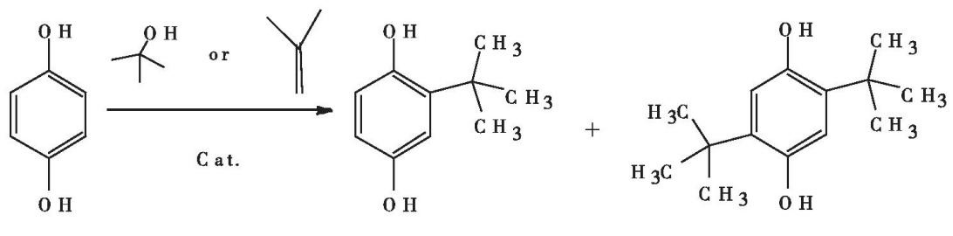
Image Source: Research Progress on the Synthesis and Application of TBHQ as an Oil Antioxidant.
II. Basic Properties
1. Physical Properties:
TBHQ appears as a white to light gray crystalline powder with a characteristic phenolic odor. It is practically insoluble in water, with a boiling point of 295°C and a melting point of 126.5–128.5°C [4]. TBHQ has excellent oil solubility and can be directly blended with oil-based raw materials. Its good dispersibility eliminates the need for additional solubilization treatments, making it suitable for various production processes of fat-rich food products [5].
2. Antioxidant Mechanism:
TBHQ reacts with free radicals generated during lipid oxidation and forms corresponding quinone compounds, thereby terminating the free radical chain reactions involved in lipid oxidation. This effectively reduces the formation of oxidation products such as aldehydes, ketones, acids, and peroxides [9], helping to preserve the original flavor and nutritional value of food products to the greatest extent possible.
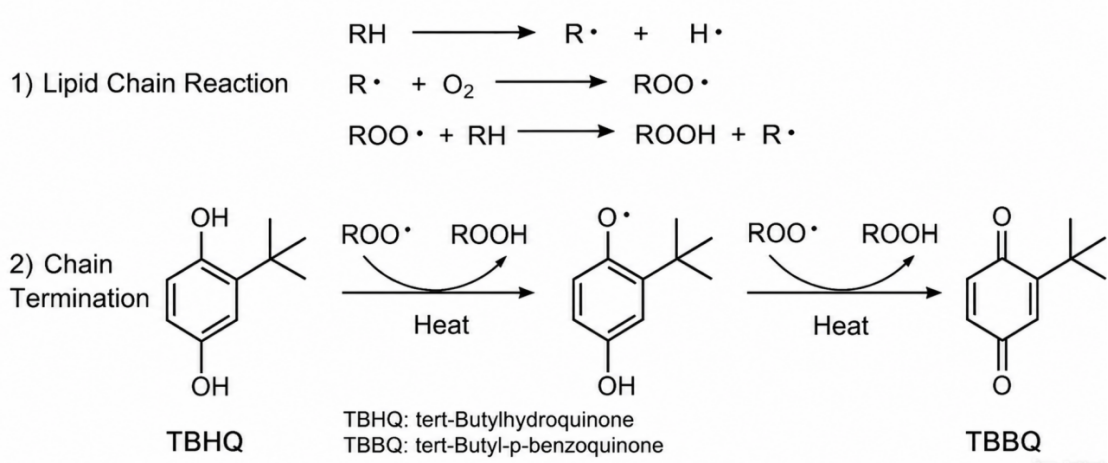
Image Source: Development of a Clean Production Process for Tert-Butylhydroquinone (TBHQ)
3. Key Advantages:
TBHQ offers high antioxidant efficiency, achieving long-lasting preservation effects with only a small amount of addition. It exhibits good thermal stability, making it suitable for food processing conditions involving high temperatures, while having no significant impact on the color or flavor of food products [6]. It demonstrates excellent antioxidant performance in various oils, particularly vegetable oils. The antioxidant capacity follows the order: TBHQ > PG > BHT > BHA [7].
4. Stability:
TBHQ has good thermal stability and does not cause discoloration in the presence of iron or copper. However, it may turn pink when exposed to light or under alkaline conditions [2].
5. Auxiliary Antimicrobial Function:
TBHQ has been reported to exhibit inhibitory effects against common food spoilage bacteria and molds [10]. In addition to its antioxidant properties, TBHQ can help enhance food safety by providing additional protection against microbial deterioration during storage.
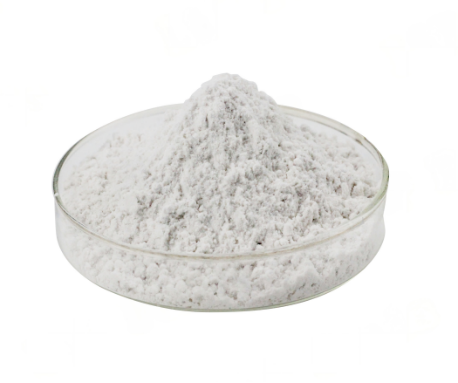
Image Source: L&P Food Ingredient Co., Ltd.
III. Widely Recognized and Approved Worldwide
China:
TBHQ is listed in GB 2760-2024 National Food Safety Standard – Standards for Uses of Food Additives, which specifies its permitted applications and maximum usage levels. It is recognized as a legally approved food antioxidant in China.
European Union:
TBHQ is approved for use under relevant EU food additive regulations, with specified dosage limits for use in edible oils and fat-containing food products.
United States:
The U.S. Food and Drug Administration (FDA) has classified TBHQ as a Generally Recognized as Safe (GRAS) substance, with a maximum permitted usage level of 0.02% based on the total fat content of the food product.
International Codex Standards:
The Codex Alimentarius Commission (CAC) has established maximum usage limits for TBHQ that are consistent with China’s national standards. The Joint FAO/WHO Expert Committee on Food Additives (JECFA) has also established a clear Acceptable Daily Intake (ADI) value for TBHQ.
IV. Safety Profile
The safety of TBHQ has been systematically evaluated through multiple toxicological assessments conducted by internationally recognized authorities. At approved usage levels, TBHQ has shown no carcinogenic, teratogenic, or mutagenic effects. The International Agency for Research on Cancer (IARC) has not classified TBHQ as a carcinogen, and it is not listed in the U.S. Department of Health and Human Services (HHS) Report on Carcinogens [8].
Toxicological Data:
The Acceptable Daily Intake (ADI) established by EFSA/JECFA for TBHQ is 0.7 mg/kg body weight per day [3].
V. Applications and Usage Limits
According to the requirements of GB 2760-2024 National Food Safety Standard – Standards for Uses of Food Additives, the maximum permitted usage level of TBHQ is uniformly set at 0.2 g/kg based on the fat content of food products, with no differences among product categories. Its application covers a wide range of fat-rich food products, including:
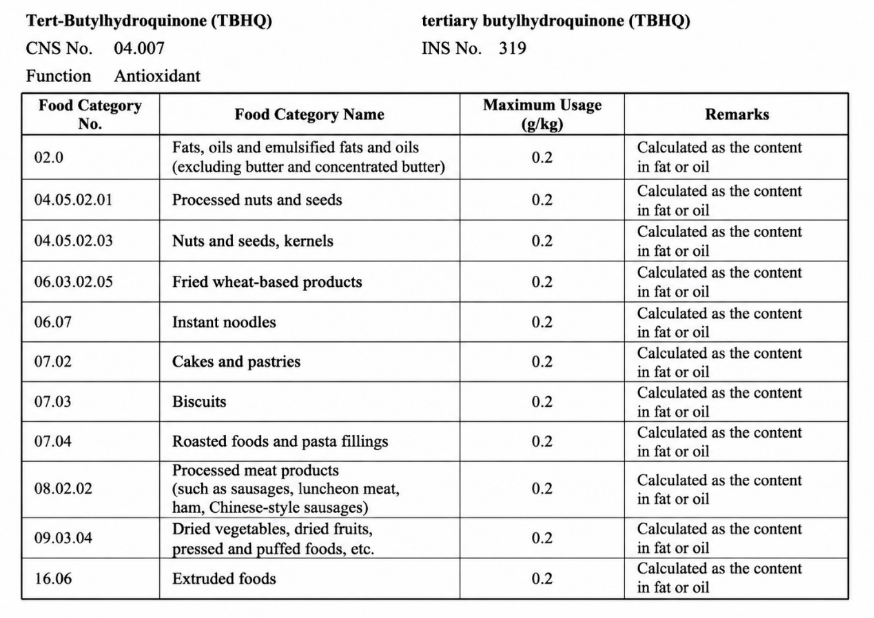
VI. Precautions: Proper Use for Optimal Performance
-
TBHQ should be fully dissolved and uniformly dispersed in the oil phase before use.
-
The addition level of TBHQ should not exceed 0.02% (calculated based on the fat/oil content).
-
Citric acid can enhance the antioxidant activity of TBHQ.
-
TBHQ should not be used in combination with PG (Propyl Gallate).
-
Avoid using TBHQ under alkaline conditions.
TBHQ is a highly efficient, compliant, and safe synthetic antioxidant widely used in the food industry. With its strong antioxidant capacity and excellent cost-effectiveness, TBHQ has become a preferred solution for preserving fat-rich food products. When used strictly within the permitted application scope and dosage limits specified by food safety regulations, TBHQ can effectively extend shelf life, maintain food quality, and ensure consumer safety. As a result, TBHQ has become an indispensable “guardian of oil freshness” in the modern food industry.
References:
[1]Xu M ,Yu Y ,Li J , et al. A mechanistic perspective: How does tert-butylhydroquinone retain antioxidative efficacy in edible oils during storage?[J].Food chemistry,2025,493(Pt 3):145963.DOI:10.1016/J.FOODCHEM.2025.145963.
[2]徐梦琪,祝振杰,陈小军,等. 特丁基对苯二酚在不同油脂贮存过程中转化产物的识别、分离与鉴定[J].食品科学,2024,45(04):42-49.
[3]王婉懿.合成酚类抗氧化剂多种类样品赋存特征及人体暴露评估[D].东北大学,2023.DOI:10.27007/d.cnki.gdbeu.2023.000766.
[4]袁利杰,张培毅,秦逸飞,等. 辣条中特丁基对苯二酚测定方法研究[J].中国卫生检验杂志,2021,31(22):2705-2709.
[5]赵荻,楼君,庄志城,等. 叔丁基对苯二酚(TBHQ)对香榧烘烤和货架品质以及抗氧化能力的影响[J].林业科学,2018,54(10):39-45.
[6]Jun L ,Yanlan B ,Huifang Y , et al. Antioxidative Properties and Interconversion of tert-Butylhydroquinone and tert-Butylquinone in Soybean Oils.[J].Journal of agricultural and food chemistry,2017,65(48):10598-10603.DOI:10.1021/acs.jafc.7b04517.
[7]韩焕美,何桂华,郑新华,等. 植物油中特丁基对苯二酚的保鲜效果[J].食品安全质量检测学报,2016,7(04):1402-1406.DOI:10.19812/j.cnki.jfsq11-5956/ts.2016.04.009.
[8] Statement on the refined exposure assessment of tertiary‐butyl hydroquinone (E 319)[J].EFSA Journal,2016,14(1):n/a-n/a.DOI:10.2903/j.efsa.2016.4363.
[9]张素娟,李家林,崔炳群,等.油脂抗氧化剂TBHQ的合成及应用研究进展[J].中国食品添加剂,2012,(03):184-189.
[10]洪伟图.叔丁基对苯二酚清洁生产工艺开发[D].厦门大学,2021.DOI:10.27424/d.cnki.gxmdu.2021.000581.
Latest Blogs
-
Sep. 21, 2026
【Food Antioxidants Series 6】 A Key Player in Lipid Preservation | Propyl Gallate (PG)
-
Sep. 21, 2026
[Exhibition Review] L&P Foods Showcases Diverse Ingredient Solutions at Fi Asia Indonesia 2026
-
Sep. 18, 2026
【Food Antioxidants Series 5】 A New Force in Natural Antioxidants | Marigold Flavonoids
-
Sep. 18, 2026
-
Sep. 15, 2026
How TBHQ Extends Shelf Life in Oils and Snacks: Mechanism and Usage Tips