

【Food Antioxidants Series 3】 Classic Lipid-Soluble Antioxidant | Tocopherols (Vitamin E)
Sep. 01, 2026
In the antioxidant system of the food industry, tocopherols (Vitamin E) are classic and widely used lipid-soluble antioxidants [1]. As an essential nutrient for the human body, tocopherols provide dual benefits of food preservation and nutritional enhancement, making them an important natural antioxidant with both practical value and functional benefits. They are highly valued and widely adopted by the food industry.
Tocopherols are widely distributed in nature. Vegetable oils such as wheat germ oil, soybean oil, and corn oil are major natural sources, while vegetables such as rapeseed, cabbage, and various nuts also contain significant amounts of tocopherols.
Tocopherols (Vitamin E)
Tocopherols, commonly known as Vitamin E, refer to a group of lipid-soluble phenolic compounds rather than a single substance [2]. Naturally occurring tocopherols exist in the d-form (natural stereoisomer) and mainly include eight major forms: α-, β-, γ-, and δ-tocopherols, as well as α-, β-, γ-, and δ-tocotrienols [6].
Among these forms, α-tocopherol is the most widely distributed and abundant form in nature, exhibiting the highest biological activity and antioxidant capacity. It is also the most important and widely applied tocopherol form in the food industry.
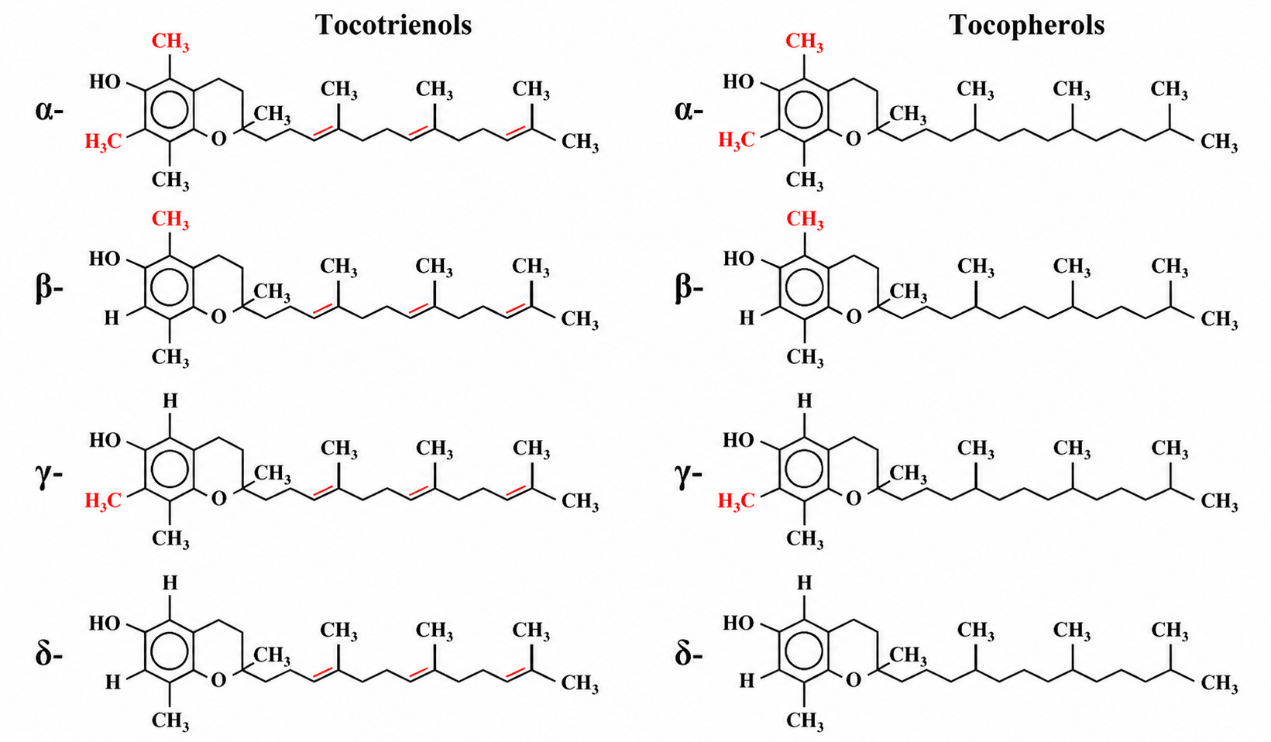
Image Source: WeChat Official Account "Silicon Carbon Mouse Personal Care Industry Circle"
Production Methods of Tocopherols
The production of tocopherols mainly involves two approaches:
-
Natural Extraction:
Natural tocopherols are extracted from raw materials such as plant oil refining by-products and wheat germ through processes including solvent extraction, molecular distillation, and purification [9]. Natural tocopherols better align with the growing demand for “natural” ingredients in the food industry. -
Synthetic Production:
Synthetic tocopherols are produced through chemical synthesis using petrochemical-based raw materials. The most common form is dl-α-tocopherol [9], which offers high cost efficiency, stable antioxidant performance, and broad applications across various food products.
Depending on processing and modification methods, tocopherols can also be converted into various esterified derivatives, such as tocopherol acetate, tocopherol succinate, and tocopherol nicotinate [12]. These derivatives provide advantages in terms of stability and solubility, further expanding the application potential of tocopherols in different fields.
Basic Properties
1. Physical Properties:
Pure tocopherol appears as a pale yellow to orange-yellow oily liquid. It is insoluble in water but readily soluble in fats, ethanol, acetone, and other organic solvents. With no obvious odor, tocopherol does not significantly affect the original flavor profile of food products after incorporation [8].
2. Antioxidant Mechanism:
As a lipid-soluble antioxidant, tocopherol possesses a lipophilic and hydrophobic structure, allowing it to penetrate the lipid phase of food systems. By donating hydrogen atoms, tocopherol captures and neutralizes lipid free radicals, interrupts oxidative chain reactions [4], and thereby protects oils and food products from oxidative deterioration.
3. Key Advantages:
Tocopherol exhibits good stability against heat and acidic conditions. Under common food processing conditions, such as cooking and baking temperatures (100–180°C), it can retain most of its antioxidant activity. In addition to antioxidant protection, tocopherol also provides nutritional fortification benefits, helping enhance the nutritional value of food products while extending shelf life, making it suitable for the development of functional and nutrition-oriented foods.
4. Stability:
Tocopherol is relatively unstable under alkaline conditions and may react with alkaline substances, resulting in reduced activity [5]. It is sensitive to oxygen and ultraviolet light, and may undergo oxidation and degradation under light exposure or high-oxygen environments; therefore, appropriate protection measures are required. Tocopherol does not exhibit significant color reactions with metal ions [7] and has no adverse impact on food appearance.
5. Other Functions:
In addition to its antioxidant role in food applications, tocopherol contributes to maintaining reproductive health and supporting immune function in the human body. Its derivatives also demonstrate properties such as moisturizing effects, anti-inflammatory activity [3], and inhibition of tyrosinase activity. Due to these multifunctional benefits, tocopherols and their derivatives are widely used in cosmetics, dietary supplements, and health-related products.
Widely Recognized and Approved Worldwide
Due to its dual role as both a food additive and a nutritional fortification ingredient, tocopherol has received official recognition worldwide. Its applications cover a wide range of food categories:
-
China:
Tocopherol is approved as a natural food antioxidant and nutritional fortification agent. Its application scope and usage limits are regulated according to GB 2760-2024 National Food Safety Standard – Standards for Uses of Food Additives and GB 14880-2012 National Food Safety Standard – Standard for the Use of Nutritional Fortification Substances in Foods. It is also included in the Inventory of Existing Cosmetic Ingredients in China (2021 Edition).
-
European Union:
The EU recognizes the antioxidant and nutritional functions of tocopherols and permits their use in products such as edible oils, dairy products, and baked goods. Clear quality standards have been established for both naturally extracted and synthetic tocopherols.
-
United States:
The U.S. Food and Drug Administration (FDA) classifies tocopherols as Generally Recognized as Safe (GRAS) substances. They can be used as antioxidants for food preservation and as nutritional fortification ingredients in various nutritional foods, without excessively restrictive usage limits.
-
Japan:
Tocopherols are permitted for use in products such as edible oils, seafood products, and dairy products. Their application in functional foods and natural preservation solutions is encouraged, highlighting their dual value in both nutrition enhancement and food protection.
Safety Profile
Tocopherol is an essential lipid-soluble vitamin required by the human body. Through extensive toxicological evaluations and long-term dietary consumption studies, tocopherol has demonstrated an excellent safety profile. At normal intake levels, it exhibits no acute toxicity, chronic toxicity, carcinogenicity, teratogenicity, or mutagenicity [11]. In addition, it can be naturally metabolized and excreted by the human body.
Dietary Intake Reference:
As a nutritional fortification ingredient, China specifies that the minimum daily intake of Vitamin E (calculated as α-tocopherol equivalents, α-TE) is 5 mg α-TE, with a maximum daily intake of 150 mg α-TE. Excessive intake (300–600 mg or more per day) may cause discomfort such as cheilitis, nausea, and dizziness. Therefore, usage levels in food applications should strictly comply with regulatory limits.
Applications and Usage Limits
According to the requirements of GB 2760-2024 National Food Safety Standard – Standards for Uses of Food Additives, the application scope and usage limits of tocopherols are as follows:
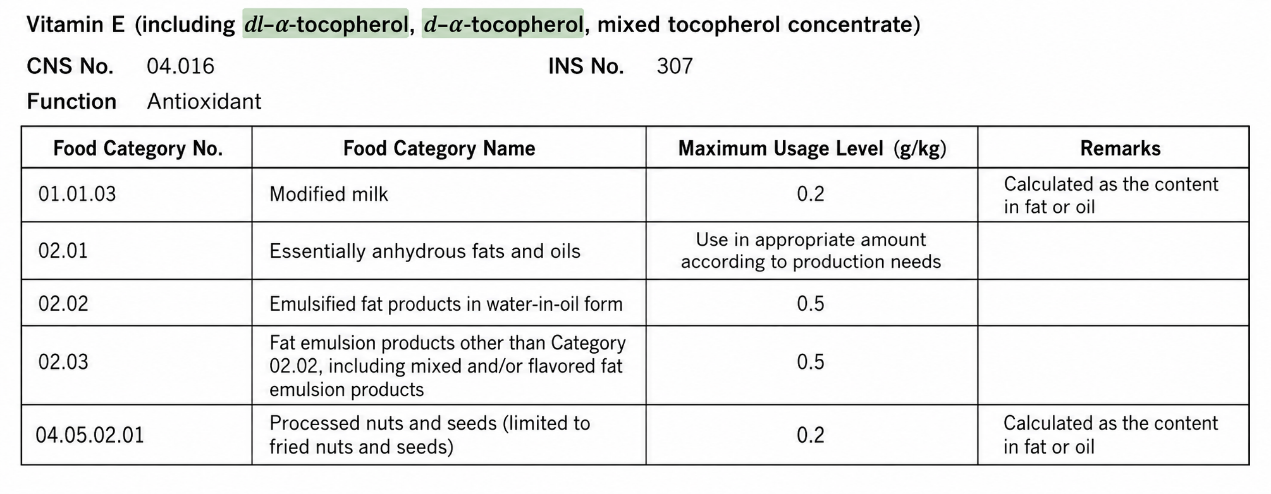
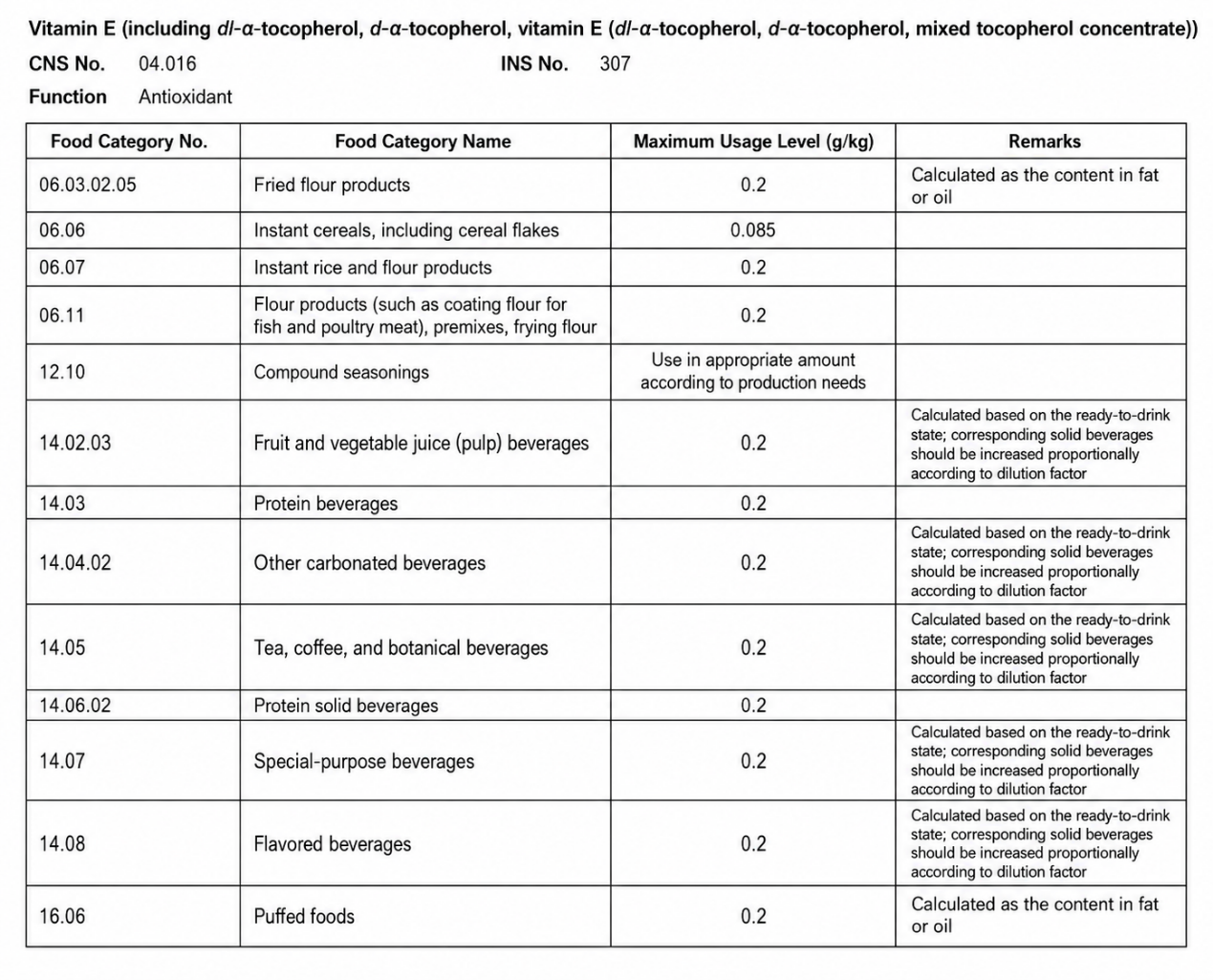
Precautions
1. Compatibility Considerations:
Tocopherol should not be used together with alkaline substances (such as sodium bicarbonate and sodium carbonate), as reactions may occur and reduce its antioxidant activity. It can be combined with natural antioxidants such as rosemary extract and tea polyphenols to achieve enhanced antioxidant performance while reducing the required amount of a single antioxidant.
2. Storage Conditions:
Tocopherol should be stored in sealed containers under light-protected, oxygen-isolated, and low-temperature conditions (recommended storage temperature ≤25°C). A small amount of antioxidant may be added to assist preservation. Exposure to direct sunlight, high temperatures, or high-oxygen environments should be avoided, as these conditions may accelerate oxidation and reduce antioxidant activity.
3. Usage Control: The usage level of tocopherol should strictly comply with regulatory limits. Excessive addition may not only cause discomfort after consumption but may also result in off-flavors caused by tocopherol oxidation, affecting food taste and quality. For foods with mild flavors, the dosage should be appropriately adjusted.
4. Dissolution Method:
As a lipid-soluble compound, tocopherol can be directly added to the oil phase of food ingredients and evenly mixed. For application in water-based food systems, tocopherol can first be emulsified with emulsifiers (such as glyceryl monostearate) before addition to ensure uniform dispersion.
5. Avoid Contact with Metal Ions:
Metal ions such as iron and copper can accelerate the oxidative degradation of tocopherol and reduce its antioxidant effectiveness. During processing, equipment or containers containing metal ions should be avoided, or chelating agents such as citric acid and EDTA can be added to remove metal ions [10].
6. Processing Compatibility:
During the processing of fried foods (temperatures ≥200°C), tocopherol activity decreases significantly and it is not suitable for use as the sole antioxidant in high-temperature frying applications. It can be combined with heat-stable antioxidants and used at low levels to provide additional preservation benefits.
Tocopherol is a classic antioxidant in the food industry that combines both “preservation and nutrition” benefits. With its wide natural availability and excellent safety profile, tocopherol can effectively delay lipid oxidation and rancidity, extend food shelf life, and provide essential Vitamin E supplementation, meeting consumer demand for healthier and more nutritious food products.
References:
[1]李欣,郭咪咪,范文广,等. 食用植物油抗氧化的研究进展[J].粮油食品科技,2024,32(03):109-116.DOI:10.16210/j.cnki.1007-7561.2024.03.011.
[2]何晨鹏,申文璨,刘寰宇,等. 维生素E抗氧化作用及其在动物生产上的应用研究进展[J].饲料工业,2024,45(07):11-14.DOI:10.13302/j.cnki.fi.2024.07.002.
[3]刘乃成.生育三烯酚在斑马鱼体内抗炎抗氧化和降血脂的功效评价[D].上海海洋大学,2023.DOI:10.27314/d.cnki.gsscu.2023.001100.
[4]郭彤,于凤芝,胡平,等. 维生素E调节抗氧化作用的研究进展[J].山东畜牧兽医,2021,42(12):42-49+53.
[5]Nathalie B ,Claire B ,Cruz M F , et al. Tocopherols as antioxidants in lipid-based systems: The combination of chemical and physicochemical interactions determines their efficiency.[J].Comprehensive reviews in food science and food safety,2021,21(1):642-688.DOI:10.1111/1541-4337.12867.
[6]李彦娇,高媛,王磊,等. 三烯生育酚研究进展[J].生物技术进展,2021,11(06):668-675.DOI:10.19586/j.2095-2341.2021.0167.
[7]Mishra K S ,Belur D P ,Iyyaswami R . Use of antioxidants for enhancing oxidative stability of bulk edible oils: a review[J].International Journal of Food Science & Technology,2020,56(1):1-12.DOI:10.1111/ijfs.14716.
[8]周洋,杨文婧,操丽丽,等. 生育酚抑制油脂氧化机制研究进展[J].中国油脂,2018,43(08):32-38.
[9]车夏宁,丁子元,许克家,等. 生育酚单体的功效、应用及分离技术研究进展[J].中国油脂,2017,42(12):103-107.
[10]李甜甜,黄丽君,周蕊,等. 维生素E在油脂中抗氧化与促氧化研究进展[J].农村经济与科技,2017,28(21):155-157+184.
[11]程强. 生育酚在油脂中的抗氧化应用[J].粮食与食品工业,2016,23(01):20-23.
[12]张旭晖,王恬. α-生育酚及其衍生物对动物生长发育的调控[J].中国饲料,2011,(02):12-17.DOI:10.15906/j.cnki.cn11-2975/s.2011.02.003.
Latest Blogs
-
Sep. 21, 2026
【Food Antioxidants Series 6】 A Key Player in Lipid Preservation | Propyl Gallate (PG)
-
Sep. 21, 2026
[Exhibition Review] L&P Foods Showcases Diverse Ingredient Solutions at Fi Asia Indonesia 2026
-
Sep. 18, 2026
【Food Antioxidants Series 5】 A New Force in Natural Antioxidants | Marigold Flavonoids
-
Sep. 18, 2026
-
Sep. 15, 2026
How TBHQ Extends Shelf Life in Oils and Snacks: Mechanism and Usage Tips