

【Food Antioxidants Series 7】 A Naturally Derived Expert in Lipid Preservation | Ascorbyl Palmitate (AP)
Oct. 10, 2026
As the food industry’s demand grows for safe, effective antioxidants with strong compatibility in antioxidant blends, Ascorbyl Palmitate (AP) has become widely used in food preservation due to its naturally derived profile, excellent antioxidant performance, and compatibility with a wide range of food systems. It is also an ideal naturally derived partner for use in combination with synthetic antioxidants, aligning with increasing consumer demand for food additives associated with healthier products.
1. Ascorbyl Palmitate
Ascorbyl Palmitate, also known as L-Ascorbyl Palmitate and abbreviated as AP, has the chemical name L-ascorbic acid 6-palmitate and is commonly referred to as Vitamin C Palmitate. It is a fat-soluble derivative of water-soluble Vitamin C [1]. AP is classified as a naturally derived, oil-soluble antioxidant and is one of the most widely used Vitamin C derivatives in the food industry.
Chemical synthesis is currently the principal method used for the industrial production of Ascorbyl Palmitate, mainly involving the acyl chloride method and direct esterification [3]. In recent years, advances in enzyme engineering—particularly the use of immobilized lipases—have made enzymatic synthesis increasingly mature. As a result, enzymatic production is gradually emerging as an important alternative to conventional chemical synthesis [5].
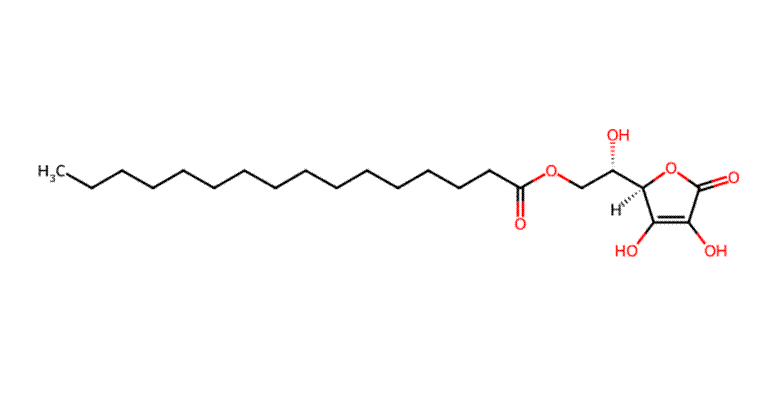
Image Source: ChemSpider
2. Basic Properties
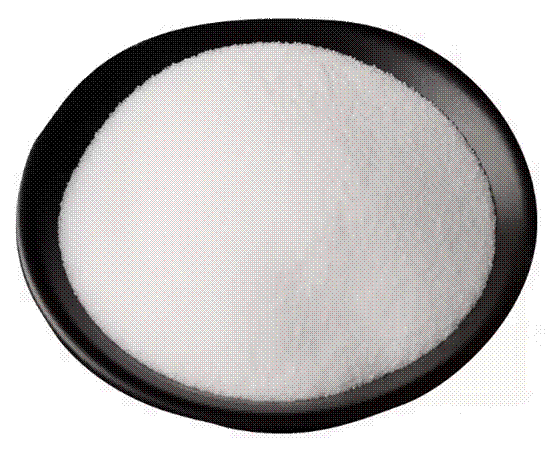
Image Source: Baidu Encyclopedia (Baidu Baike)
2.1 Physical Properties
Ascorbyl Palmitate is a white to pale yellow crystalline powder that is odorless and slightly acidic in taste. It has a melting point of 107–117°C. It is practically insoluble in water but readily soluble in ethanol, acetone, and vegetable and animal fats and oils [3]. AP exhibits excellent dispersibility in fats and oils and can be blended directly with lipid-based ingredients. It is suitable for a variety of food-processing applications, including frying, baking, and dairy manufacturing, without altering the original physical characteristics of the food.
2.2 Antioxidant Mechanism
As a hydrogen donor, Ascorbyl Palmitate reacts with free radicals generated during lipid oxidation to form stable ascorbyl radicals, thereby effectively terminating the free-radical chain reaction. This mechanism reduces the formation of oxidation products such as peroxides and aldehydes [2].
In addition, AP can reduce peroxides that have already formed in food and chelate pro-oxidant metal ions such as iron and copper. Through these multiple mechanisms, it helps inhibit lipid rancidity while preserving the original flavor and nutritional value of food [7].
2.3 Key Advantages
Derived from Vitamin C, AP combines antioxidant functionality with the nutritional benefits associated with Vitamin C and avoids the potential concerns sometimes associated with phenolic antioxidants.
It provides effective antioxidant protection for both vegetable oils and animal fats and is particularly suitable for products with stringent additive-safety requirements, such as dairy products and foods for infants and young children [4]. AP also offers good thermal stability and can withstand high-temperature food-processing operations, including frying and baking, without adversely affecting the color or flavor of the finished product.
2.4 Stability
Ascorbyl Palmitate remains stable when stored at room temperature under dry conditions and protected from light. Its antioxidant activity is best maintained under acidic conditions but decreases in alkaline environments.
Prolonged exposure to light, high temperatures, or humid conditions may cause gradual degradation; appropriate storage protection is therefore required. When AP comes into contact with metal ions, its chelating action can reduce their pro-oxidant activity without causing discoloration, making it suitable for processing systems involving metal containers or equipment [7].
2.5 Nutritional and Additional Functions
Ascorbyl Palmitate can also be used as a nutritional fortifier. In addition to providing antioxidant protection, it can contribute Vitamin C activity and enhance the nutritional value of food.
AP is considered non-irritating to the human body. Following absorption, it can be metabolized into Vitamin C and palmitic acid, both of which are physiologically relevant substances [8].
3. Broad Recognition in China and International Markets
-
China: Ascorbyl Palmitate is included in GB 2760-2024, National Food Safety Standard—Standard for the Use of Food Additives. It is also classified as a food nutrient fortifier. The standard specifies its permitted applications and maximum use levels for its dual functions as an antioxidant and nutritional fortifier, confirming its regulatory acceptance as a naturally derived food additive.
-
European Union: Ascorbyl Palmitate is authorized as food additive E304 for use in fats and oils, dairy products, bakery products, and other lipid-rich foods. It complies with applicable EU regulations governing food additives.
-
United States: Ascorbyl Palmitate is classified by the U.S. Food and Drug Administration (FDA) as Generally Recognized as Safe (GRAS). It is permitted for use at appropriate levels in applications such as foods for infants and young children, dairy products, and fats and oils, and is a commonly used antioxidant in the U.S. food industry.
-
Other markets: Ascorbyl Palmitate is also approved for use in Japan, Canada, Australia, and numerous other countries. It is widely recognized by the global food industry as a safe and effective oil-soluble antioxidant.
4. Safety
The safety of Ascorbyl Palmitate has been systematically evaluated on multiple occasions by leading international authorities. It is regarded as one of the food antioxidants with a well-established safety profile.
As a derivative of Vitamin C, AP can be broken down in the body into L-ascorbic acid and palmitic acid, both of which can be metabolized and absorbed through normal physiological processes, without accumulation. Authorities including the European Food Safety Authority (EFSA) have concluded that, when appropriately used in food, Ascorbyl Palmitate does not present carcinogenic, teratogenic, or mutagenic concerns [6].
The Joint FAO/WHO Expert Committee on Food Additives (JECFA) has established an Acceptable Daily Intake (ADI) of 0–1.25 mg/kg body weight, expressed as ascorbic acid [9].
5. Applications and Maximum Use Levels
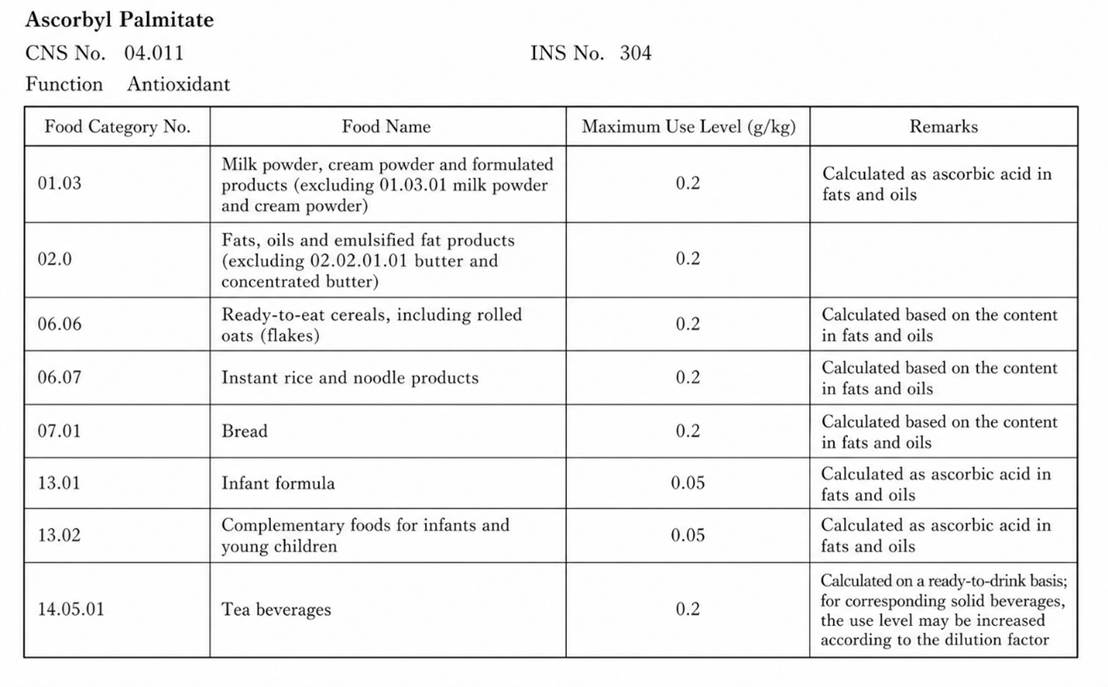
Under the requirements of GB 2760-2024, the maximum permitted use level of AP as an antioxidant varies according to the food category. Its principal applications and corresponding maximum use levels are as follows:
6. Precautions: Proper Use for Optimum Performance
-
AP may be added directly to melted fats or oils and mixed thoroughly until uniformly dispersed, without requiring an additional solubilizing agent. As it dissolves more slowly in fats and oils at low temperatures, moderate heating to 50–60°C may be applied to accelerate dissolution.
-
The amount used must be strictly controlled in accordance with the maximum permitted level specified for each food category under applicable national standards. Excessive use must be avoided.
-
AP is preferably used in acidic or neutral food systems. Strongly alkaline systems should be avoided, as alkaline conditions may reduce its antioxidant activity.
-
AP should be stored in a tightly sealed container in a cool, dry place protected from light, preferably at a temperature below 25°C. Exposure to high temperatures, moisture, and intense light should be avoided to prevent degradation and loss of activity.
AP is a classic, naturally derived, safe, and effective fat-soluble antioxidant widely used in the food industry. It combines antioxidant functionality with nutritional fortification value, making it an important ingredient for protecting food quality. When used scientifically and in compliance with applicable regulations, AP helps preserve the freshness and original flavor of food while providing reliable support for product quality and shelf-life stability.
References
[1]郭红雨,张逸,刘忠慧,等. 抗坏血酸棕榈酸酯的制备及应用进展[J/OL].食品工业科技,1-12[2026-03-09].https://doi.org/10.13386/j.issn1002-0306.2025060003.
[2]张诣康.L-抗坏血酸棕榈酸酯调控食用期植物油抗氧化能力的机制研究[D].江南大学,2024.DOI:10.27169/d.cnki.gwqgu.2024.001990.
[3]Ajala T B .抗坏血酸棕榈酸酯:特性、合成、包埋及应用综述[D].华南理工大学,2023.DOI:10.27151/d.cnki.ghnlu.2023.001342.
[4]张羽飞,刘铁良,郑明明. 抗坏血酸棕榈酸酯对植物油的抗氧化作用[J].中国油脂,2024,49(01):79-83.DOI:10.19902/j.cnki.zgyz.1003-7969.220640.
[5]张润润,石玉刚,黄欣莹,等. 化学与生物法制备抗坏血酸棕榈酸酯及其食品应用研究进展[J].中国粮油学报,2018,33(07):130-137.
[6]Sohrabi Y ,Aghdash M H ,Baghbani E , et al. Cytotoxicity and Genotoxicity Assessment of Ascorbyl Palmitate (AP) Food Additive[J].Advanced Pharmaceutical Bulletin,2018,8(2):341-346.DOI:10.15171/apb.2018.039.
[7]刘威嘉. 天然油脂抗氧化剂及其产业化应用研究进展[J].中国调味品,2016,41(08):155-160.
[8]龚欣.抗坏血酸棕榈酸酯的合成及应用研究[D].华南理工大学,2014.
[9]雷琳. L-抗坏血酸棕榈酸酯的抗氧化性研究[J].中国医药导报,2009,6(17):13-14.
Latest Blogs
-
Oct. 21, 2026
Beyond One-Size-Fits-All Phosphatidylserine(PS): Matrix Solutions for Brain Health Innovation
-
Oct. 21, 2026
BHA vs TBHQ: Which Antioxidant is Better for Food Preservation?
-
Oct. 20, 2026
【Food Antioxidants Series 9】Classic Water-Soluble Natural Antioxidant | Ascorbic Acid
-
Oct. 20, 2026
Focusing on Health Management Solutions, L&P Foods Showcases at AAES 2026
-
Oct. 14, 2026
【Food Antioxidants Series 8】A Natural Plant-Based Antioxidant Classic | Tea Polyphenols