

【Food Antioxidants Series 8】A Natural Plant-Based Antioxidant Classic | Tea Polyphenols
Oct. 14, 2026
As the food industry continues to shift toward natural, healthy, and sustainable solutions, plant-derived natural antioxidants have become an important alternative to synthetic antioxidants. With their excellent antioxidant activity, abundant raw material sources, and multiple physiological benefits, tea polyphenols have become one of the most widely used natural antioxidants in the food industry. They are particularly suitable for extending the shelf life of various high-fat foods, offering both preservation and nutritional benefits while meeting consumers’ growing demand for natural food additives.
Tea originated in China, and the main raw materials for tea polyphenol extraction include fresh tea leaves, tea-processing residues, and lower-grade tea leaves. This enables the comprehensive utilization of tea resources and further increases the added value of the tea industry. As tea is a traditional beverage in China, tea polyphenols extracted from tea leaves also offer a strong natural image that better meets consumers’ expectations for safe and natural food additives.
I. Tea Polyphenols
Tea polyphenols are a natural mixture of polyphenolic compounds extracted from the fresh leaves and young shoots of Camellia plants. They are produced through processes such as solvent extraction, purification, concentration, and drying. Catechins are the major active components, accounting for approximately 60%–80% of total tea polyphenols. Among them, epigallocatechin gallate (EGCG) exhibits the strongest antioxidant activity and is considered the key component responsible for the antioxidant effects of tea polyphenols [8].
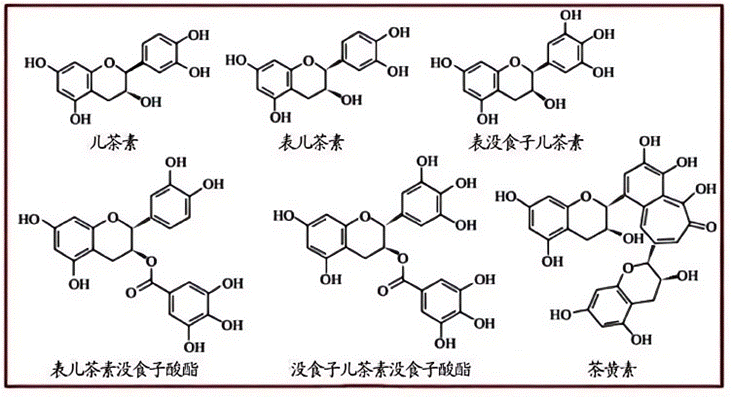
Image source: WeChat Official Account “Lao Xie Tea Talk”
Tea polyphenols are mainly produced from tea leaves and tea-processing by-products. Common extraction methods include aqueous extraction followed by ethanol precipitation [2] and organic solvent extraction. Some high-grade products also use advanced purification technologies such as membrane separation and column chromatography to achieve higher purity [4]. Depending on the raw materials and production processes used, commercial tea polyphenol products are available in different purity grades, such as 90%, 95%, and 98%.
II. Basic Properties
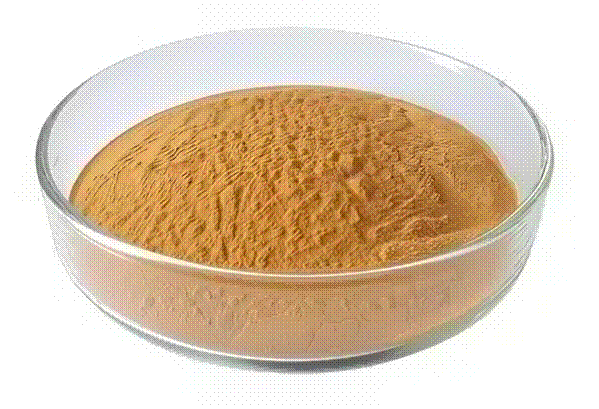
Image Source: Baidu Encyclopedia (Baidu Baike)
1.Physical properties: The pure product is a light yellow to yellow-brown powder with an astringent taste. It is hygroscopic and has good water solubility. It is readily soluble in water, ethanol, and ethyl acetate, but only slightly soluble in oils and fats [7].
2.Antioxidant mechanism: Catechins, the main active components of tea polyphenols, contain multiple phenolic hydroxyl groups. They can efficiently scavenge oxygen radicals, hydroxyl radicals, and other free radicals in food systems by donating hydrogen atoms [9], thereby directly interrupting the chain reactions of lipid peroxidation. Tea polyphenols can also inhibit the activity of enzymes such as lipoxygenase and polyphenol oxidase [11], helping to reduce oxidative deterioration at its source. Their antioxidant capacity is significantly higher than that of traditional antioxidants such as vitamin C and vitamin E [5].
The antioxidant activity of individual components in tea polyphenols varies. On a molecular-weight basis, the antioxidant activity follows the order: EC < ECG < EGC < EGCG [6].
3.Key advantages: Tea polyphenols are derived from widely available natural sources. Tea leaves are renewable agricultural resources, and the utilization of tea-processing by-products is consistent with environmentally friendly and sustainable production practices. They have a broad antioxidant spectrum and can inhibit multiple types of oxidative reactions, making them suitable for a variety of food systems. In addition, tea polyphenols possess both antioxidant and certain antimicrobial properties [12], providing dual protection to help extend food shelf life.
4.Stability: Tea polyphenols show good stability in acidic and neutral environments (pH 2–7), with a high retention of antioxidant activity. They also have a certain degree of heat resistance, although their activity gradually decreases at temperatures above 200°C. They are relatively sensitive to light and oxygen and are prone to oxidative degradation under light exposure or high-oxygen conditions. Their aqueous solution generally has a pH of 3.0–4.0. In the presence of iron, tea polyphenols can form greenish-black complexes [10], while under alkaline conditions they are easily oxidized and may undergo browning.
5.Other functions: In addition to their use as food antioxidants, tea polyphenols have been reported to exhibit physiological effects such as anti-inflammatory activity, lipid-lowering effects, and cardiovascular protection [3]. They can also adsorb undesirable odors in foods, giving them a certain deodorizing effect. Tea polyphenols may help protect food pigments, serving not only as natural coloring substances but also helping to reduce color fading during storage [1].
III. Widely Recognized in China and Abroad, with Mature Application Standards
As a classic natural food antioxidant, tea polyphenols have been officially recognized for their functionality and safety in many countries and regions around the world. Their application standards and processing systems are well established, making them one of the mainstream natural antioxidants used in the food industry:
-
China: Tea polyphenols are listed in GB 2760-2024 National Food Safety Standard – Standard for Uses of Food Additives as an approved natural food antioxidant, with CNS No. 04.006. Clear application categories and maximum usage levels are specified. They may also be used as auxiliary ingredients in food fortification.
-
European Union: Tea polyphenols are permitted for use as natural antioxidants and are included in the EU food additive system. Their applications cover oils and fats, meat products, baked foods, and other categories, with specific quality requirements for product purity and catechin content.
-
United States: The FDA recognizes tea polyphenols as Generally Recognized as Safe (GRAS) substances. They may be used for food preservation and antioxidation without strict maximum usage limits. Naturally extracted tea polyphenols are particularly favored in the natural food market.
-
Japan: The natural antioxidant properties of tea polyphenols are recognized, and they are widely used in oils and fats, aquatic products, beverages, and other foods. Their identity as plant extracts is emphasized, making them well suited to the Japanese market’s preference for natural food ingredients.
-
Codex Alimentarius Commission (CAC): Tea polyphenols are included within the category of permitted food antioxidants, providing a standardized basis for their international application.
IV. Safety
Tea polyphenols are natural extracts derived from tea leaves. Their safety has been supported by multiple toxicological studies and long-term consumption experience in China and abroad. They show no acute or chronic toxicity and have not demonstrated carcinogenic, teratogenic, or mutagenic effects. At normal usage levels, they can be metabolized and eliminated by the human body without significant accumulation risk.
The ADI (Acceptable Daily Intake) established by JECFA for tea polyphenols is 0–25 mg/kg body weight [13].
V. Applications and Maximum Usage Levels
According to GB 2760-2024 National Food Safety Standard – Standard for Uses of Food Additives, the application scope and maximum usage levels of tea polyphenols as food antioxidants are listed below. Oil-soluble tea polyphenols may refer to the corresponding maximum usage levels for the same food categories.
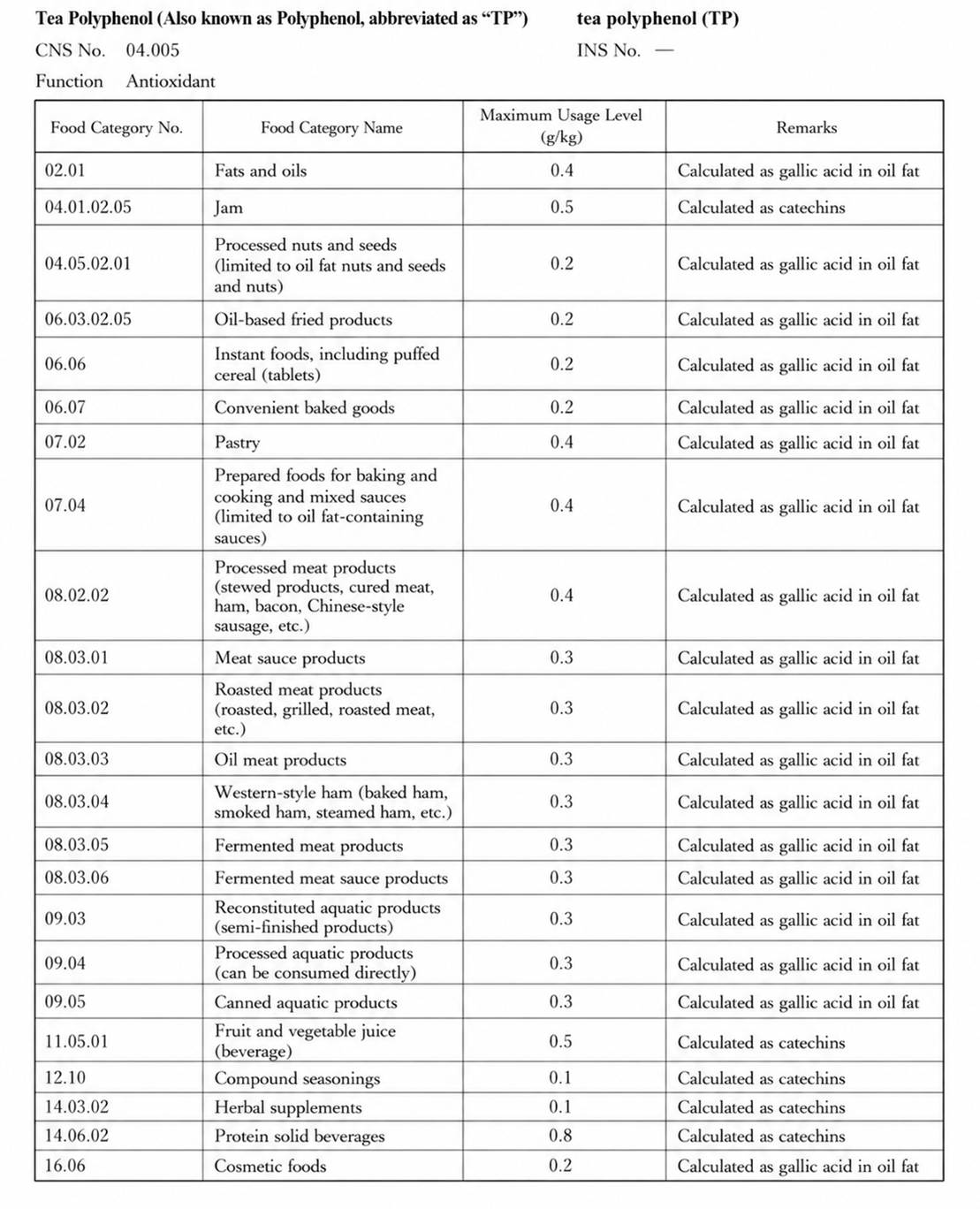
VI. Precautions
1.Compatibility: Tea polyphenols should not be mixed with strongly alkaline substances such as sodium bicarbonate or sodium hydroxide. In alkaline systems with a pH above 8, their antioxidant activity may decrease significantly. They can be combined with natural antioxidants such as rosemary extract, tocopherols (vitamin E), and phytic acid [7]. Such combinations may produce synergistic antioxidant effects, helping improve antioxidant efficiency and broaden their application range.
2.Storage conditions: Tea polyphenols should be stored in tightly sealed containers in a cool, dry place protected from light. A storage temperature of ≤20°C and relative humidity of ≤60% are recommended. Exposure to moisture, direct sunlight, and high temperatures should be avoided. Tea polyphenols are hygroscopic and may form lumps during storage. If no deterioration has occurred, the lumps can be ground before use without affecting activity.
3.Dosage control: Tea polyphenols should be used in strict accordance with the maximum permitted levels specified in relevant national standards. Excessive use may not only increase production costs, but may also impart an overly strong tea-like aroma to mild-flavored foods. In addition, high addition levels may cause a slight yellow-brown color, which could affect the appearance of light-colored foods.
4.Packaging requirements: Oxygen- and light-barrier packaging materials, such as aluminum foil bags or vacuum packaging, are recommended. After opening, the product should be used as soon as possible. Any remaining material should be resealed and stored at a low temperature to minimize oxidation and loss of active components.
As a natural, efficient, safe, and multifunctional polyphenolic antioxidant, tea polyphenols meet the preservation needs of industrial food production while also aligning with consumer demand for natural and healthy foods. They provide a high-quality natural solution for the continued development of the modern food industry.
References:
[1]郭洁. 茶多酚在食品工业中的应用及其市场前景[J].福建茶叶,2026,48(02):116-118.
[2]刘红钰,李亭洁,罗思容,等. 茶多酚的提取纯化与利用研究综述[J].农产品加工,2026,(01):128-131.DOI:10.16693/j.cnki.1671-9646(X).2026.01.026.
[3]林毅,钟茂生,陈泽宇,等. 茶多酚生物学功能及其应用[J].纤维素科学与技术,2025,33(03):55-60.DOI:10.16561/j.cnki.xws.2025.03.05.
[4]丛雪.绿茶中茶多酚的提取及抗氧化活性研究[D].烟台大学,2025.DOI:10.27437/d.cnki.gytdu.2025.000582.
[5]İlhami Gulcin. Antioxidants: a comprehensive review[J].Archives of Toxicology,2025,99(5):1-105.DOI:10.1007/S00204-025-03997-2.
[6]魏景利,贾菲. 茶多酚的生物活性及其在食品中的应用研究进展[J].食品安全导刊,2025,(10):92-94.DOI:10.16043/j.cnki.cfs.2025.10.031.
[7]方兵. 天然抗氧化剂在食品工业中的应用探究[J].中外食品工业,2024,(23):23-25.
[8]陈炳银,陈红平,田宝明,等. 茶多酚作为食品添加剂的应用研究进展[J].中国茶叶,2024,46(11):33-44.
[9]蒋心怡,傅立妮,麦倩雯,等. 茶多酚抗氧化增效及其在油脂保鲜中的应用研究进展[J].中国茶叶加工,2024,(02):41-46.DOI:10.15905/j.zgcyjg.2095-0306.2024.02.06.
[10]徐锦添,张晨曦,张宇. 茶多酚的提取分离技术与其体外抗氧化活性研究[J].农产品加工,2024,(06):78-85.DOI:10.16693/j.cnki.1671-9646(X).2024.06.019.
[11]李响.天然抗氧化剂对食用油的协同抗氧化作用及机理研究[D].广西大学,2023.DOI:10.27034/d.cnki.ggxiu.2023.001986.
[12]Xinzhou W ,Yanan L ,Zufang W , et al. Tea Polyphenols: A Natural Antioxidant Regulates Gut Flora to Protect the Intestinal Mucosa and Prevent Chronic Diseases[J].Antioxidants,2022,11(2):253-253.DOI:10.3390/ANTIOX11020253.
[13]Yan Z ,Zhong Y ,Duan Y , et al. Antioxidant mechanism of tea polyphenols and its impact on health benefits[J].Animal Nutrition,2020,6(2):115-123.DOI:10.1016/j.aninu.2020.01.001.
Latest Blogs
-
Oct. 21, 2026
Beyond One-Size-Fits-All Phosphatidylserine(PS): Matrix Solutions for Brain Health Innovation
-
Oct. 21, 2026
BHA vs TBHQ: Which Antioxidant is Better for Food Preservation?
-
Oct. 20, 2026
【Food Antioxidants Series 9】Classic Water-Soluble Natural Antioxidant | Ascorbic Acid
-
Oct. 20, 2026
Focusing on Health Management Solutions, L&P Foods Showcases at AAES 2026
-
Oct. 14, 2026
【Food Antioxidants Series 8】A Natural Plant-Based Antioxidant Classic | Tea Polyphenols