

【Food Antioxidants Series 9】Classic Water-Soluble Natural Antioxidant | Ascorbic Acid
Oct. 20, 2026
Among natural food antioxidants, ascorbic acid (vitamin C) is a long-established and widely used water-soluble antioxidant, as well as an essential nutrient for the human body. With its natural characteristics, high water solubility, and dual functions, ascorbic acid has become a classic choice in the food industry for both preservation and nutritional fortification. It meets consumers’ demand for natural, healthy, and multifunctional food additives and plays an important role in beverages, fruit and vegetable products, meat products, and many other food categories.
I. Ascorbic Acid
Ascorbic acid, also known as vitamin C, is a naturally occurring water-soluble six-carbon sugar acid. It is an essential water-soluble vitamin for the human body and also a classic natural water-soluble antioxidant widely used in the food industry [1]. Food-grade ascorbic acid can be produced either by natural extraction or industrial synthesis, both of which comply with national food additive safety standards.
The production of ascorbic acid mainly involves two industrialized methods:
1. Natural extraction: Ascorbic acid can be extracted from fresh fruits and vegetables, as well as fruit and vegetable processing by-products, through processes such as aqueous extraction, purification, and crystallization [12]. Products obtained through this method have strong natural positioning and are suitable for premium natural food applications.
2. Bio-fermentation production: Glucose is used as the raw material and converted through microbial fermentation, transformation, and purification processes [7]. This is currently the mainstream method for industrial production, offering high purity and good cost performance, with product purity reaching over 99%.
In addition, derivatives of ascorbic acid, such as sodium ascorbate, calcium ascorbate, and ascorbyl palmitate, offer improved stability and lipid solubility after modification [4], further expanding the application of ascorbic acid in the food industry.
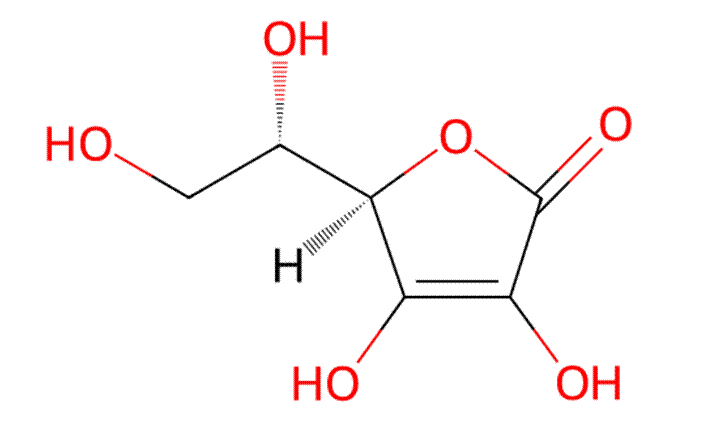
Image Source: ChemSpider
II. Basic Properties
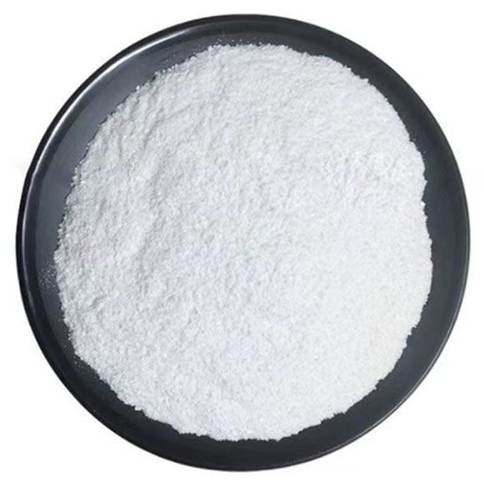
Image Source: Baidu Encyclopedia (Baidu Baike)
1. Physical properties: Ascorbic acid is a white to slightly yellow crystalline substance or crystalline powder. It is odorless and has a sour taste. It is highly soluble in water, with a solubility of approximately 330 g/L at 25°C, slightly soluble in ethanol, and insoluble in non-polar solvents such as ether and chloroform, making it a typical water-soluble antioxidant [9]. Its aqueous solution is weakly acidic, with a pH of approximately 2.5–3.5. When added to foods, it can also help adjust acidity without introducing undesirable odors.
2. Antioxidant mechanism: As a strong reducing agent, ascorbic acid can efficiently scavenge reactive oxygen species such as superoxide anions and hydroxyl radicals in food systems by donating electrons and hydrogen atoms [3], thereby directly interrupting the chain reaction of lipid peroxidation [11]. It can also reduce oxidized antioxidants such as vitamin E and tea polyphenols back to their active forms, enabling antioxidant regeneration and improving the overall antioxidant performance of the system [8].
3. Key advantages: Ascorbic acid has excellent water solubility and is one of the most commonly used natural water-soluble antioxidants in the food industry, making it suitable for a wide range of aqueous food systems [2]. It provides both antioxidant protection and nutritional fortification. While helping preserve food quality, it also supplies vitamin C, an essential nutrient for the human body, thereby enhancing the nutritional value of foods. In addition, it can help inhibit browning in fruits and vegetables and improve the color of meat products, offering multiple functions in a single ingredient.
4. Stability: Ascorbic acid shows good stability in acidic environments with a pH below 4 and retains relatively high antioxidant activity under such conditions. However, it is sensitive to heat, oxygen, and ultraviolet light and can be readily oxidized and degraded during high-temperature processing, light exposure, or in high-oxygen environments. Its stability decreases significantly under alkaline conditions, where isomerization and loss of activity may occur. Contact with metal ions such as iron and copper can accelerate oxidation, so direct contact with these metals should be minimized [9].
5. Other functions: In addition to its antioxidant role in foods, ascorbic acid is important for collagen synthesis in the human body and is associated with physiological functions such as supporting immune function, promoting iron absorption, and helping protect against oxidative stress [3]. In food applications, it can also be used as an acidity regulator, color-protecting agent, and processing aid in leavening systems, making it a multifunctional food ingredient.
III. Widely Recognized Worldwide with Mature Application Standards
Ascorbic acid has the dual functions of a food additive and a nutritional fortifier. Its functionality, safety, and practical value have been officially recognized in most countries and regions worldwide:
-
China: Ascorbic acid is included in GB 2760-2024 National Food Safety Standard – Standard for Uses of Food Additives and may be used as an antioxidant, color-protecting agent, and acidity regulator. Relevant CNS numbers include 04.014 for ascorbic acid and 04.015 for sodium ascorbate.
-
European Union: Ascorbic acid and its derivatives are recognized for multiple functions, including E300 (L-ascorbic acid), E301 (sodium ascorbate), E302 (calcium ascorbate), and E305 (ascorbyl palmitate). Their use complies with EU Regulation (EC) No 1333/2008 on food additives and covers a wide range of food categories.
-
United States: The FDA recognizes ascorbic acid as a Generally Recognized as Safe (GRAS) substance. It may be used as an antioxidant, nutritional fortifier, and color-protecting agent in various foods. Naturally derived ascorbic acid is particularly favored in the natural food market.
-
Japan: Ascorbic acid and its derivatives are widely permitted for use in beverages, fruit and vegetable products, meat products, oils and fats, and other foods. Their nutritional and natural characteristics make them well suited to the health-oriented demands of the Japanese food market.
IV. Safety
Ascorbic acid is an essential water-soluble vitamin for the human body. Its safety has been supported by decades of toxicological studies and long-term consumption experience worldwide. At normal usage levels, it shows no acute or chronic toxicity and has not demonstrated carcinogenic, teratogenic, or mutagenic effects [13]. Excess amounts that are not absorbed can be excreted through urine, with no significant risk of accumulation in the body.
JECFA has evaluated the ADI of ascorbic acid as 0–15 mg/kg body weight, with no identified toxicological threshold.
V. Applications and Maximum Usage Levels
According to GB 2760-2024 National Food Safety Standard – Standard for Uses of Food Additives, the main application categories and maximum usage levels of ascorbic acid and its commonly used derivatives as food antioxidants are as follows:
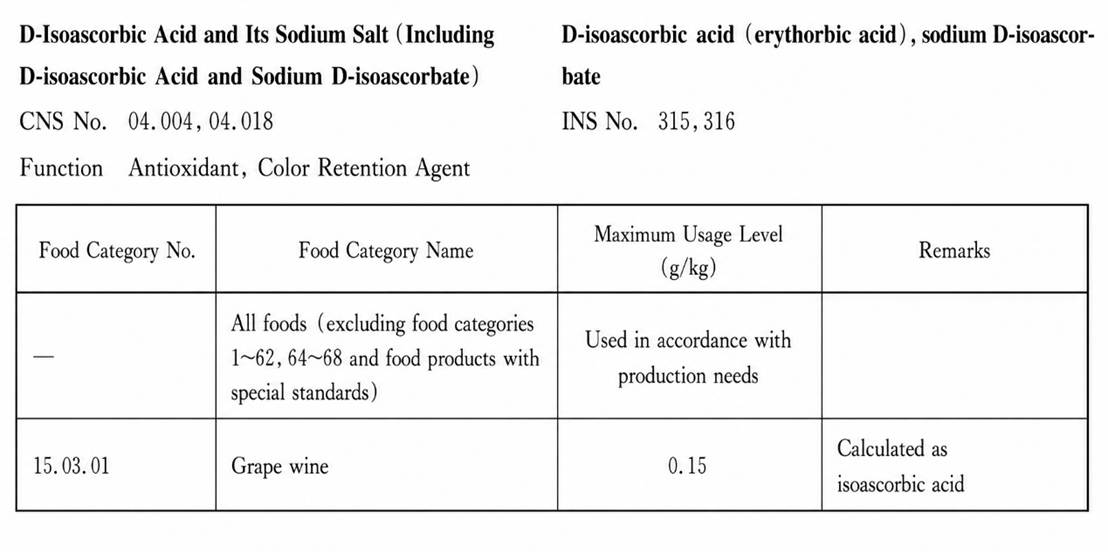
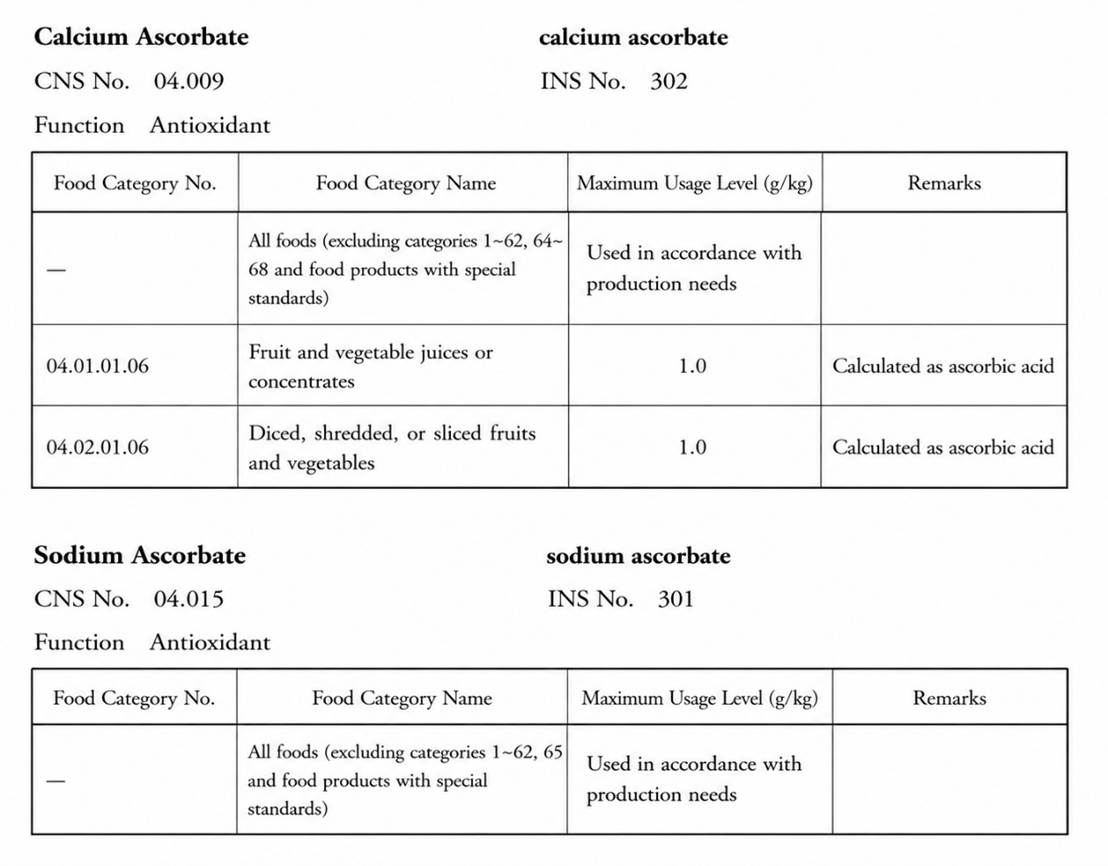
VI. Precautions
1. Compatibility: Ascorbic acid should not be mixed with strongly alkaline substances such as sodium bicarbonate and sodium hydroxide, or with metal ions such as iron and copper salts. Alkaline conditions accelerate its oxidation and loss of activity, while metal ions can catalyze oxidation reactions and significantly reduce its antioxidant activity [6]. It can be combined with citric acid, tocopherols, tea polyphenols, rosemary extract, and other antioxidants. Such combinations may produce synergistic antioxidant effects while helping compensate for the stability limitations of individual antioxidants [5].
2. Storage conditions: Ascorbic acid should be stored in a tightly sealed container in a cool, dry place protected from light. A storage temperature of ≤25°C and relative humidity of ≤60% are recommended. Ascorbic acid is highly hygroscopic and may easily cake and oxidize after absorbing moisture. Oxygen- and light-barrier packaging, such as aluminum foil bags or vacuum packaging, is recommended. After opening, the product should be used as soon as possible, and any remaining material should be resealed. During processing and storage, containers made of iron, copper, or similar metals should be avoided. Stainless steel, glass, or food-grade plastic containers are recommended to prevent metal ions from accelerating oxidation.
3. Dissolution method: Water-soluble ascorbic acid and its derivatives can be dissolved directly in cold or warm water and then added to the aqueous phase of the food system with thorough mixing. Dissolution at high temperatures should be avoided, as temperatures above 80°C may accelerate oxidation.
4. Color protection applications: In meat products, ascorbic acid can be used together with nitrites to help reduce the required nitrite level while inhibiting the formation of nitrosamines, thereby improving the safety of meat products [10]. For color protection in fruits and vegetables, a 0.1%–0.5% aqueous solution may be prepared. Fruits and vegetables can be immersed in the solution for several minutes and then removed, which can effectively help prevent browning.
Ascorbic acid is a classic natural, water-soluble, and multifunctional antioxidant in the food industry. With abundant raw material sources, mature production technology, and a broad range of applications, it can efficiently scavenge free radicals, delay oxidative rancidity, help prevent browning in fruits and vegetables, and improve the color of meat products. At the same time, it provides essential vitamin C, delivering an integrated combination of preservation, nutritional fortification, and color protection.
References:
[1]方兵. 天然抗氧化剂在食品工业中的应用探究[J].中外食品工业,2024,(23):23-25.
[2]马丽霞,莫卓华,何少峰. 天然抗氧化剂在饮料食品中的应用分析[J].现代食品,2023,29(18):115-117.DOI:10.16736/j.cnki.cn41-1434/ts.2023.18.035.
[3]Agnieszka G ,Elżbieta S . Antioxidative and Anti-Inflammatory Activity of Ascorbic Acid[J].Antioxidants,2022,11(10):1993-1993.DOI:10.3390/ANTIOX11101993.
[4]张鹤型.Vc衍生物抗氧剂的合成工艺研究[D].青岛科技大学,2022.DOI:10.27264/d.cnki.gqdhc.2022.000655.
[5]徐杭蓉. 天然抗氧化剂在食品饮料中的应用[J].食品工业,2022,43(04):287-289.
[6]侯亚琼,张冬洁,温荣,等. 乳品中天然抗氧化剂的研究进展[J].食品安全导刊,2022,(05):156-158.DOI:10.16043/j.cnki.cfs.2022.05.067.
[7]B. L K S ,N. A V B ,V. L P , et al. Essential features for antioxidant capacity of ascorbic acid (vitamin C)[J].Journal of Molecular Modeling,2021,28(1):1-1.DOI:10.1007/S00894-021-04994-9.
[8]刘贺,朱奕昊,刘亭亭,等. 天然抗氧化剂及协同作用研究进展[J].聊城大学学报(自然科学版),2021,34(05):59-65.DOI:10.19728/j.issn1672-6634.2021.05.009.
[9]孙式兴. 天然食品抗氧化剂的研究进展[J].食品安全导刊,2021,(15):177+179.DOI:10.16043/j.cnki.cfs.2021.15.100.
[10]张蕊,仝媛媛,陈龙,等. 天然来源的抗氧化剂的临床应用及研究进展[J].山东化工,2020,49(22):48-52.DOI:10.19319/j.cnki.issn.1008-021x.2020.22.018.
[11]Njus D ,Kelley M P ,Tu Y , et al. Ascorbic acid: The chemistry underlying its antioxidant properties[J].Free Radical Biology and Medicine,2020,15937-43.DOI:10.1016/j.freeradbiomed.2020.07.013.
[12]张逸伟,许敏,林东恩. 抗坏血酸衍生物的合成及其抗氧化活性[J].合成化学,2013,21(06):743-746.DOI:10.15952/j.cnki.cjsc.2013.06.029.
[13]Lu X ,Nan M ,Zhang H . Investigation of the Antioxidant Property of Ascorbic Acid[J].The journal of physical chemistry, C. Nanomaterials and interfaces,2007,111(41):14998-15002.
Latest Blogs
-
Oct. 21, 2026
Beyond One-Size-Fits-All Phosphatidylserine(PS): Matrix Solutions for Brain Health Innovation
-
Oct. 21, 2026
BHA vs TBHQ: Which Antioxidant is Better for Food Preservation?
-
Oct. 20, 2026
【Food Antioxidants Series 9】Classic Water-Soluble Natural Antioxidant | Ascorbic Acid
-
Oct. 20, 2026
Focusing on Health Management Solutions, L&P Foods Showcases at AAES 2026
-
Oct. 14, 2026
【Food Antioxidants Series 8】A Natural Plant-Based Antioxidant Classic | Tea Polyphenols