

Synergistic Antioxidant Effects and Mechanisms of BHA with Common Synthetic Antioxidants
Oct. 31, 2022
In September 2022, Jun Li et al. published a study entitled “Insight into synergistic antioxidation mechanisms of butyl hydroxyanisole with common synthetic antioxidants” in Grain & Oil Science and Technology.
The study elucidates the synergistic antioxidant effects and underlying mechanisms of butylated hydroxyanisole (BHA) when used in combination with other common synthetic antioxidants [1].
Image Source: Grain & Oil Science and Technology
BHA is a commonly used synthetic antioxidant, typically applied in oils and fat-containing foods to prevent lipid oxidation, particularly in oils rich in highly unsaturated fatty acids.
Chen et al. [2] reported that during three weeks of storage at 60 °C, BHA significantly improved the oxidative stability of sunflower oil. At a dosage of 200 mg/kg BHA, the peroxide value was 102 mmol/kg, the acid value was 0.34 mg KOH/g, and the p-anisidine value was 14.7, compared with the control group, which exhibited a peroxide value of 136 mmol/kg, an acid value of 0.71 mg KOH/g, and a p-anisidine value of 24.0.
Previous studies have indicated that, due to the presence of only one phenolic hydroxyl group and steric hindrance caused by the tert-butyl group, the antioxidant activity of BHA alone is relatively limited. Consequently, BHA is commonly used in combination with other synthetic antioxidants, where it exhibits pronounced synergistic antioxidant effects.
The study employed an AAPH-induced oxidation system to investigate the synergistic antioxidant effects of BHA in combination with BHT and TBHQ. The concentrations of BHA, BHT, TBHQ, and their transformation products were quantified using high-performance liquid chromatography (HPLC), while the transformation products were further identified by LC–MS and GC–MS analyses.
The results showed that, compared with AAPH-oxidized BHA alone and AAPH-oxidized BHT alone, the loss rate of BHT in the AAPH-oxidized BHA + BHT system increased significantly (P < 0.05), whereas the loss rate of BHA decreased significantly (P < 0.05).
These findings indicate that when BHA is combined with a synergist of comparable antioxidant activity, such as BHT, BHA and the synergist competitively participate in the antioxidation process. Upon radical collision, BHA can be regenerated by the synergist (BHT), thereby enhancing the overall antioxidant efficiency of the system.
When BHA was combined with a synergist exhibiting higher antioxidant activity, such as TBHQ, the percentage of remaining BHA in the AAPH-oxidized BHA + TBHQ system remained essentially unchanged, whereas the percentage of remaining BHA in the AAPH-oxidized BHA system alone decreased markedly. In addition, the percentage of remaining TBHQ in the AAPH-oxidized BHA + TBHQ system was comparable to that observed in the AAPH-oxidized TBHQ system. These results indicate that the synergistic antioxidant effect between BHA and TBHQ is largely attributable to the protective mechanism of TBHQ.
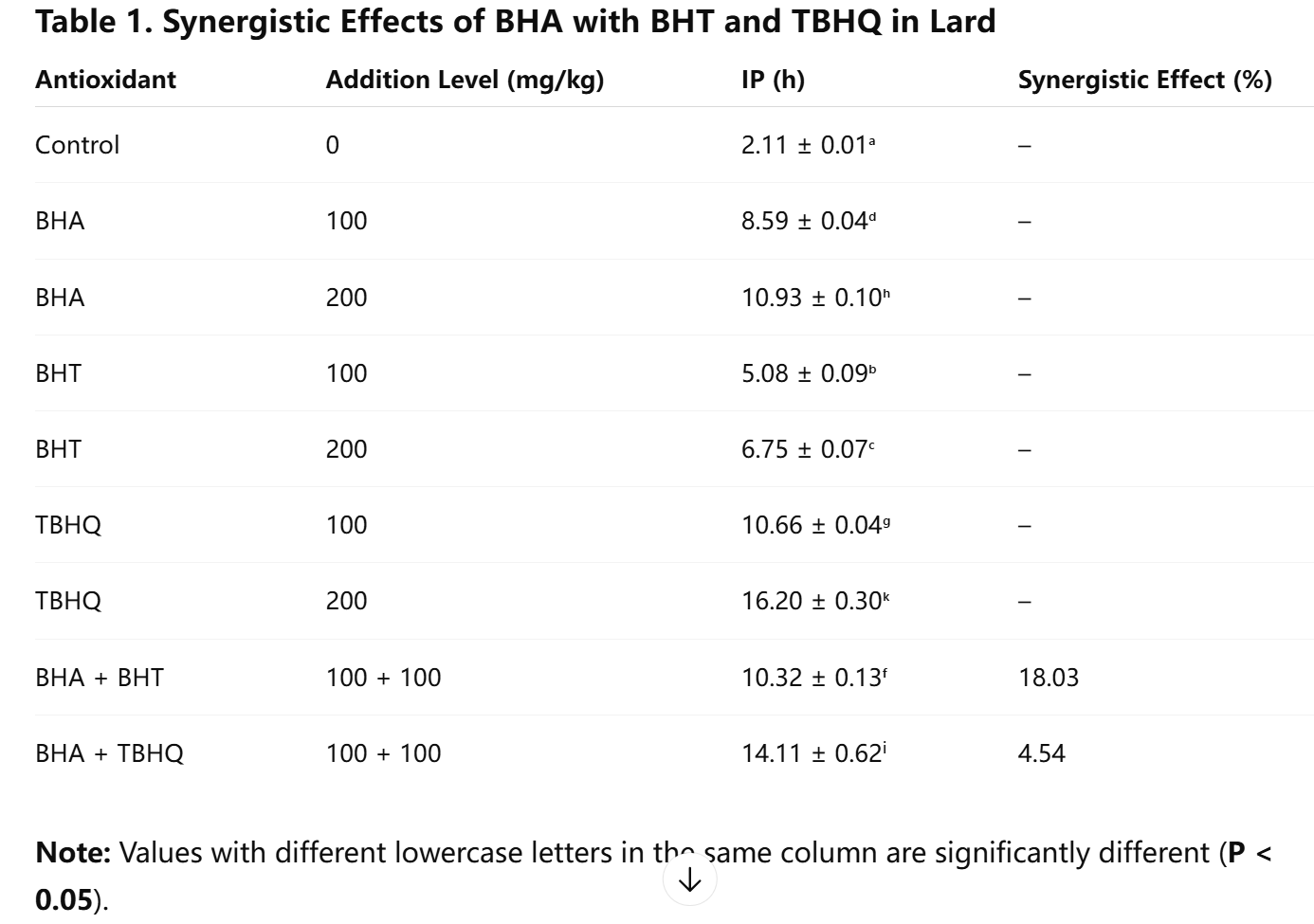
The study further evaluated the antioxidant performance of BHA in combination with BHT and TBHQ in lard using the Rancimat method. The results showed that, compared with the control, the induction period (IP) of lard was significantly prolonged by the addition of BHA, TBHQ, or BHT. Antioxidant concentration had a pronounced effect on the IP of lard, with higher antioxidant levels resulting in substantially longer IPs than lower levels.
The synergistic effects of the BHA + BHT and BHA + TBHQ combinations were calculated to be 18.03% and 4.54%, respectively, further confirming the synergistic interactions between BHA and BHT or TBHQ.
Data source: Grain & Oil Science and Technology
This study reported the loss patterns of BHA and synergists during the synergistic antioxidation process and elucidated the mechanisms underlying the synergistic antioxidant interactions between BHA and its synergists. These findings are expected to promote innovative applications of BHT and provide guidance for the combined use of BHA with other synthetic antioxidants.
About L&P Food Ingredient Co., Ltd
L&P Food Ingredient Co., Ltd (L&P Foods) is a professional manufacturer specializing in food additives and functional food ingredients. The company holds comprehensive production qualifications, including valid manufacturing licenses and a full range of internationally recognized management system certifications, including Quality Management (ISO 9001), Food Safety Management (ISO 22000), Religious Certifications (KOSHER and HALAL), Occupational Health and Safety (ISO 45001), Environmental Management (ISO 14001), as well as the Global Standard for Food Safety (BRC). With consistent and reliable product quality, a well-established after-sales service system, and the capability to provide customized solutions tailored to customer needs, L&P Foods has become a trusted and preferred supplier for downstream manufacturers.
Reference:
[1]Jun Li, Jiali Chen, Yanlan Bi, Huifang Yang,Insight into synergistic antioxidation mechanisms of butyl hydroxyanisole with common synthetic antioxidants,Grain & Oil Science and Technology,Volume 5, Issue 3,2022,P114-130.[2]X.Chen,Y.Zhang,Y.Zu,et al.Antioxidant effects of rosemary extracts on sunflower oil compared with synthetic antioxidants.Int.J.Food Sci.Technol.,49(2014), P385-391.
[2]X.Chen,Y.Zhang,Y.Zu,et al.Antioxidant effects of rosemary extracts on sunflower oil compared with synthetic antioxidants.Int.J.Food Sci.Technol.,49(2014), P385-391.
Latest Blogs
-
Sep. 21, 2026
【Food Antioxidants Series 6】 A Key Player in Lipid Preservation | Propyl Gallate (PG)
-
Sep. 21, 2026
[Exhibition Review] L&P Foods Showcases Diverse Ingredient Solutions at Fi Asia Indonesia 2026
-
Sep. 18, 2026
【Food Antioxidants Series 5】 A New Force in Natural Antioxidants | Marigold Flavonoids
-
Sep. 18, 2026
-
Sep. 15, 2026
How TBHQ Extends Shelf Life in Oils and Snacks: Mechanism and Usage Tips